This comprehensive middle school science reading passage explains how the Moon orbits Earth, aligned with NGSS standard MS-ESS1-2 and disciplinary core idea MS-ESS1.B. Students explore the Moon's slightly elliptical orbital path, which takes approximately 27 days to complete one revolution around Earth. The passage examines how Earth's gravity keeps the Moon in orbit while the Moon travels at speeds of about 2,300 miles per hour at an average distance of 238,000 miles. Students discover that the Moon's orbit gradually carries it farther from Earth each year. Audio-integrated features support diverse learners, including English Language Learners and struggling readers. The passage includes key vocabulary terms such as orbit, elliptical, gravity, revolution, and astronomical unit. Engaging activities reinforce understanding through multiple-choice questions, writing prompts, and graphic organizers that help students visualize the Earth-Moon system and analyze cause-and-effect relationships in celestial mechanics.
Written by Workybooks TeamPublished by Workybooks
Preview
Sample passage and quiz content
CONTENT PREVIEW
Expand content preview
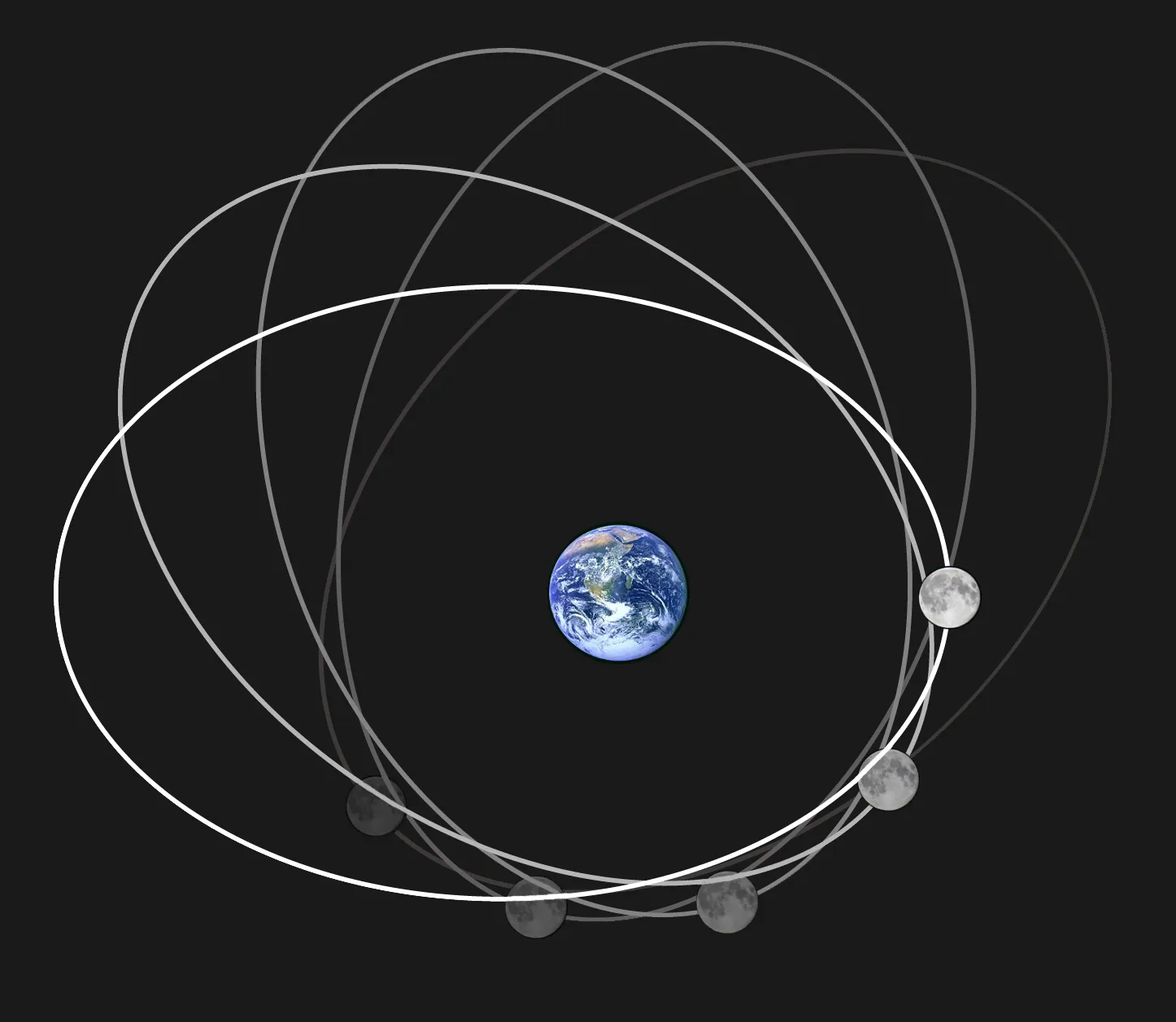
The image shows the rotation of the Moon's orbit within its orbital plane "Moon apsidal precession" by Rfassbind / Wikimedia Commons.
The Moon orbits Earth in a continuous path that takes about 27 days to complete. This movement happens because gravity from Earth pulls on the Moon constantly. The Moon follows a slightly elliptical path rather than a perfect circle. This means the Moon's distance from Earth changes slightly during each orbit.
Scientists observe that the Moon travels at approximately 2,300 miles per hour as it moves through space. Earth's gravity provides the force needed to keep the Moon from flying off into space. The Moon stays at an average distance of about 238,000 miles from Earth. This distance represents roughly 30 Earth diameters placed side by side. The Moon completes one revolution around Earth while also rotating once on its own axis. This explains why we always see the same side of the Moon from Earth.
Evidence shows that the Moon's orbit changes over time in measurable ways. The Moon moves about 1.5 inches farther from Earth each year. Scientists measure this change using laser beams reflected off mirrors placed on the Moon's surface during Apollo missions. This gradual movement happens because tidal forces between Earth and the Moon transfer energy. The Moon's orbital speed and Earth's gravity remain balanced, which keeps the Moon in a stable path. Without this balance, the Moon could either crash into Earth or escape into space.
The Moon's orbit affects Earth in important ways that we can observe. The Moon's gravitational pull creates ocean tides on Earth. These tides rise and fall twice each day as Earth rotates. The Moon's position also causes solar and lunar eclipses when Earth, Moon, and Sun align. Understanding the Moon's orbit helps scientists predict these events accurately. Space agencies use knowledge of the Moon's path to plan spacecraft missions and satellite launches.
Interesting Fact: The Moon is slowly stealing rotational energy from Earth, which makes Earth's days get longer by about 1.7 milliseconds every century. In 600 million years, a day on Earth may last 25 hours instead of 24!
How long does it take the Moon to complete one orbit around Earth?
About 24 hoursAbout 27 daysAbout 30 daysAbout 365 days
What force keeps the Moon in orbit around Earth?
MagnetismFrictionGravityWind
What does the word 'elliptical' mean in the context of the Moon's orbit?
Perfectly circularSlightly oval-shapedSquare-shapedStraight line
Approximately how fast does the Moon travel as it orbits Earth?
About 100 miles per hourAbout 500 miles per hourAbout 2,300 miles per hourAbout 10,000 miles per hour
Based on the passage, why do we always see the same side of the Moon from Earth?
The Moon does not rotate at allThe Moon rotates once during each orbit around EarthEarth rotates faster than the MoonThe Moon's gravity prevents it from rotating
How do scientists measure the Moon's gradual movement away from Earth?
By using telescopes to observe the MoonBy measuring ocean tidesBy using laser beams reflected off mirrors on the MoonBy tracking spacecraft orbiting the Moon
What would happen to the Moon if Earth's gravity suddenly disappeared?
The Moon would crash into EarthThe Moon would fly off into spaceThe Moon would stop moving completelyThe Moon would start orbiting the Sun instead
How does the Moon's orbit affect Earth?
It creates ocean tides and causes eclipsesIt changes Earth's seasonsIt controls Earth's weather patternsIt makes Earth spin faster
True or False: The Moon's distance from Earth remains exactly the same throughout its orbit.
TrueFalse
True or False: The Moon is gradually moving farther away from Earth each year.
TrueFalse
Who it's for
Perfect for the way you teach
Teachers
Build comprehension skills
Auto-graded quiz
Differentiated reading
Parents
Read together at home
Improve fluency
Quiet reading time
Homeschoolers
Reading curriculum support
Independent practice
Track Lexile growth
Topics
Moon orbitEarth-Moon systemgravityelliptical orbitlunar revolutionspace scienceMS-ESS1-2middle school astronomy
Reviews & Ratings
No reviews yet. Be the first to share your experience!
More reading you might love
20 more
Comets
This middle school science passage explores the fascinating world of comets, commonly known as 'dirty snowballs.' Studen...
MS-ESS1-2
Mercury: Closest to the Sun
This comprehensive, standards-aligned passage explores Mercury—the smallest and closest planet to the Sun. Students in g...
MS-ESS1-2MS-ESS1-3
Venus: Earth's Twin?
This comprehensive science passage for grades 6-8 examines Venus—often called Earth's twin—by exploring its similarities...
MS-ESS1-2MS-ESS1-3
Earth: Our Home Planet
This comprehensive science passage for grades 6-8 explores Earth’s unique characteristics and the interconnected systems...
MS-ESS1-2
Mars: The Red Planet
This middle school science passage explores Mars, the Red Planet, providing students in grades 6-8 with a comprehensive ...
MS-ESS1-2MS-ESS1-3
Kepler's Laws of Planetary Motion
This comprehensive middle school science passage explores Kepler's Laws of Planetary Motion, meeting NGSS Standard MS-ES...
MS-ESS1-2
Tides and Tidal Forces
This middle school science passage explores the mechanisms of tides and tidal forces, aligning with NGSS standards MS-ES...
MS-ESS1-1MS-ESS1-2
Escape Velocity and Space Travel
This middle school science passage introduces students to the concept of escape velocity—the minimum speed required to b...
MS-ESS1-2MS-PS2-4
Weightlessness and Microgravity
This science reading passage for middle school students explores the phenomenon of weightlessness and microgravity. Alig...
MS-PS2-4MS-ESS1-2
Orbits and Orbital Motion
This middle school science passage, aligned with NGSS MS-ESS1-2 and MS-PS2-4, explores the science of orbits and orbital...
MS-ESS1-2MS-PS2-4
What Is the Solar System?
This passage provides a comprehensive overview of the solar system for grades 6-8, aligned with NGSS standards MS-ESS1-2...
MS-ESS1-2MS-ESS1-3
Structure of the Solar System
This comprehensive science reading passage introduces middle school students (grades 6-8) to the structure of the solar ...
MS-ESS1-2MS-ESS1-3
Moons of the Solar System
This comprehensive passage, designed for grades 6-8 and aligned to NGSS standard MS-ESS1-2, delves into the fascinating ...
MS-ESS1-2
Defining Life: What Are We Looking For?
This informational science passage for middle school students explores the question: What is life, and how do we define ...
MS-LS1-1MS-ESS1-2
Astronomy
This comprehensive reading passage introduces middle school students to the science of astronomy, which is the study of ...
MS-ESS1-2MS-ESS1-3MS-PS4-2MS-ETS1-1
The Solar System
This middle school science passage introduces students to the solar system, aligning with NGSS standards MS-ESS1-2 and M...
MS-ESS1-2MS-ESS1-3
Gravity and Orbits
This comprehensive passage for grades 6-8 explains the science of gravity and orbits, aligning with NGSS standard MS-ESS...
MS-ESS1-2
The Inner Planets
This comprehensive science passage for grades 6-8 explores the inner (terrestrial) planets of our solar system—Mercury, ...
MS-ESS1-2MS-ESS1-3
The Outer Planets
This engaging science passage for grades 6-8 introduces students to the outer planets—Jupiter, Saturn, Uranus, and Neptu...
MS-ESS1-2MS-ESS1-3
Tides
This comprehensive middle school science reading passage explores the phenomenon of ocean tides, aligned to NGSS standar...