How GPS Works in Your Phone
Interactive passage with audio narration, comprehension questions, and printable PDF.
By completing this purchase you agree to our Terms of Use and Privacy Policy. Your subscription renews automatically until you cancel. You can cancel anytime from your account settings. All sales are final and non-refundable. Digital content is available for download in your account immediately upon purchase.
What's included
How GPS Works in Your Phone preview and details
About this printable How GPS Works in Your Phone science reading passage, NGSS-aligned (Grades 5-8)
Sample passage and quiz from How GPS Works in Your Phone
Reading passage and comprehension quiz preview
How GPS Works in Your Phone
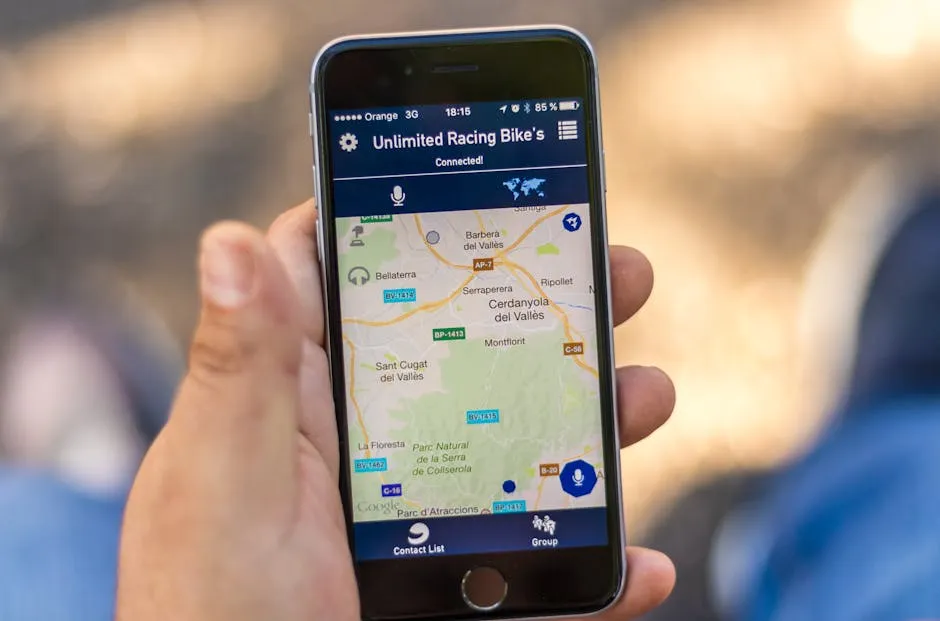
"Hand holding smartphone displaying a GPS map application with location data." by George Sultan / Pexels.
When you open a map app on your phone, it shows your exact location within seconds. This happens because your phone uses the Global Positioning System, or GPS. GPS depends on a network of about 30 satellites orbiting Earth in medium Earth orbit. These satellites circle our planet at an altitude of roughly 12,500 miles above the surface. Your phone calculates its location by timing signals from at least four of these satellites.
Each GPS satellite constantly broadcasts radio signals that travel at the speed of light. These signals include information about the satellite's position and the exact time the signal was sent. Your phone receives these signals and measures how long each one took to arrive. Since the signals travel at a known speed, your phone can calculate the distance to each satellite. This process is called trilateration. With distances from three satellites, your phone can determine your position on Earth's surface. A fourth satellite helps correct timing errors and improves accuracy. The entire calculation happens in less than a second.
GPS satellites must stay in precise orbits to work correctly. Scientists explain that these satellites complete two full orbits around Earth each day. They travel at speeds of about 8,700 miles per hour. Ground stations on Earth monitor the satellites and send updates to keep their clocks synchronized. Even tiny timing errors can cause location mistakes. Evidence shows that a timing error of just one millionth of a second can result in a position error of about 1,000 feet. This is why GPS satellites carry extremely accurate atomic clocks.
The GPS system has changed how people navigate and explore Earth. Farmers use GPS to guide tractors across fields with precision. Scientists track animal migrations and study how species move across continents. Emergency responders locate people who need help. The U.S. military developed GPS in the 1970s, but the government made it available for civilian use in the 1990s. Today, billions of devices worldwide rely on these orbiting satellites. GPS demonstrates how understanding orbital mechanics leads to practical applications that affect daily life.
Interesting Fact: GPS satellites are solar-powered and built to last about 10 years, but many continue working for 15 years or longer. The satellites are constantly being replaced and upgraded to improve accuracy and add new features.
Comprehension quiz (10 questions)
1. How many GPS satellites does your phone need to determine your location?
2. At what altitude do GPS satellites orbit Earth?
3. What does the term 'trilateration' mean in the context of GPS?
4. What information do GPS satellite signals include?
5. Why do GPS satellites need atomic clocks?
6. If a GPS satellite has a timing error of one millionth of a second, what position error might result?
7. Based on the passage, how does your phone calculate distance to a satellite?
8. What role do ground stations play in the GPS system?
9. True or False: GPS satellites complete two full orbits around Earth each day.
10. True or False: The GPS system was originally developed for civilian use in the 1970s.
Perfect for the way you teach
- Build comprehension skills
- Auto-graded quiz
- Differentiated reading
- Read together at home
- Improve fluency
- Quiet reading time
- Reading curriculum support
- Independent practice
- Track Lexile growth