How to Prevent Floods
Interactive passage with audio narration, comprehension questions, and printable PDF.
By completing this purchase you agree to our Terms of Use and Privacy Policy. Your subscription renews automatically until you cancel. You can cancel anytime from your account settings. All sales are final and non-refundable. Digital content is available for download in your account immediately upon purchase.
What's included
How to Prevent Floods preview and details
About this printable How to Prevent Floods science reading passage, NGSS-aligned (Grades 3-5)
Sample passage and quiz from How to Prevent Floods
Reading passage and comprehension quiz preview
How to Prevent Floods

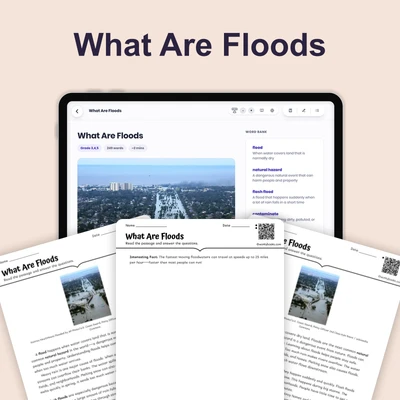
Floods happen when too much water covers land that is usually dry. This can damage homes, roads, and crops. Engineers have designed many solutions to prevent or reduce flooding and protect communities.
One important solution is levees, which are walls made of earth or concrete built along rivers. Levees keep water from overflowing onto land during heavy rains or snowmelt. Dams are another solution that control the flow of water. Dams store water in large lakes called reservoirs and release it slowly over time, preventing sudden floods downstream.
Cities use storm drains and channels to carry excess rainwater away from streets and buildings. Without these drains, water would pool on roads and flood neighborhoods. Retention ponds are special areas that collect extra water during heavy rain. The water stays in the pond and slowly soaks into the ground or evaporates instead of flooding nearby areas.
Some communities are planting more trees and creating green spaces that absorb rainwater naturally. Tree roots and soil act like sponges, soaking up water before it can cause flooding. Each solution works differently, and many communities use several methods together to provide the best protection against floods.
Interesting Fact: The Netherlands has built over 2,000 miles of levees and dams because much of the country sits below sea level. Without these flood prevention systems, nearly half the country would be underwater!
Comprehension quiz (8 questions)
1. What are levees made of?
2. What do dams store water in?
3. Where are storm drains used?
4. Why do communities plant trees for flood prevention?
5. How do retention ponds help prevent floods?
6. What would happen without storm drains in cities?
7. Communities use only one method to prevent floods.
8. What does the word 'absorb' mean?
Perfect for the way you teach
- Build comprehension skills
- Auto-graded quiz
- Differentiated reading
- Read together at home
- Improve fluency
- Quiet reading time
- Reading curriculum support
- Independent practice
- Track Lexile growth