Leif Erikson Reaches America — Reading Comprehension
Rate this
Premium Resource
Present
Present in classroom. No work saved
Assign
Classroom with student accounts, Track progress
Quick Play
No student accounts, assign with a link
Grades
5
6
7
8
PRINT+DIGITAL RESOURCE
This learning resource is available in interactive and printable formats. The interactive worksheet can be played online and assigned to students. The Printable PDF version can be downloaded and printed for completion by hand.
This passage explores Leif Erikson’s historic voyage from Greenland to Vinland (part of North America) around 1000 CE, nearly 500 years before Columbus. Students will learn about Norse exploration, archaeological evidence at L'Anse aux Meadows, and how geography influenced the journey. The passage includes disciplinary vocabulary, a glossary, Spanish translation, and engaging activities such as a reading quiz, writing prompts, and graphic organizers. Designed to support critical thinking and historical inquiry, this resource aligns with CA HSS 6.7.1 and CCSS RH.6-8.1, helping students master world history standards. Audio read-aloud and Spanish translation provide additional support for diverse learners.
CONTENT PREVIEW
Expand content preview
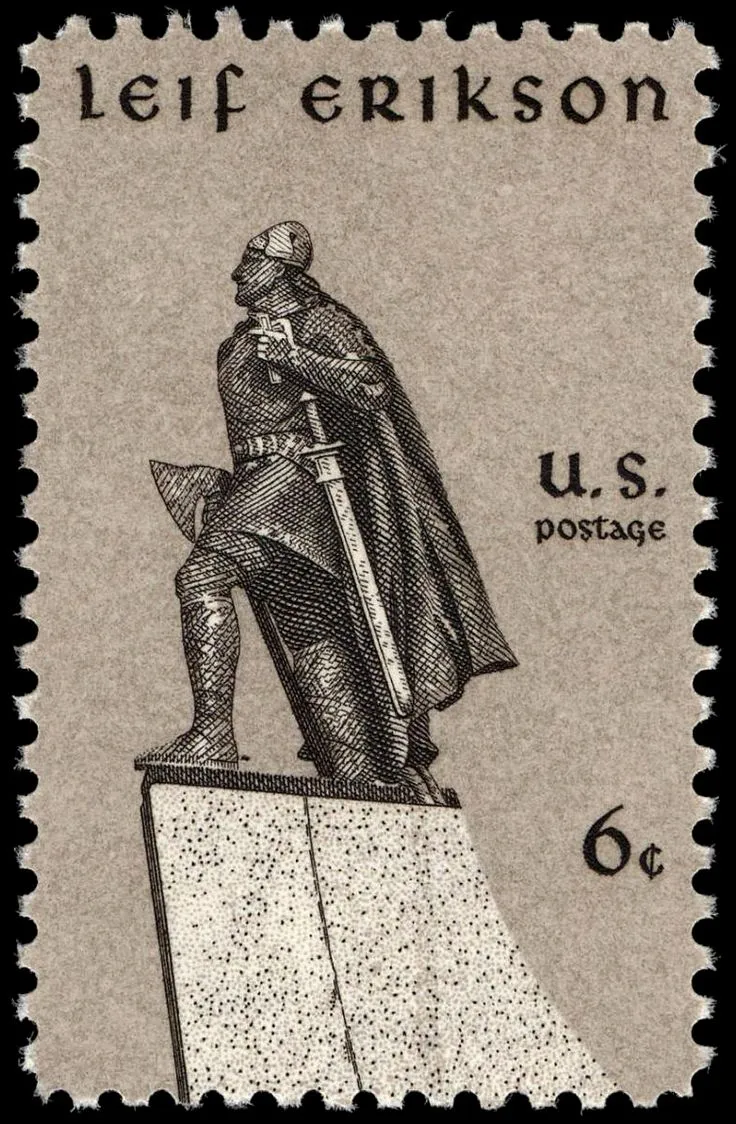
"Leif Erikson 6c 1968 issue" by Bureau of Engraving and Printing: image enlarged, rendered for tone and clarity by Gwillhickers / Wikimedia Commons.
Leif Erikson was a Norse explorer who is known for leading one of the first European expeditions to North America. Around the year 1000 CE, nearly 500 years before Christopher Columbus, Leif sailed from Greenland and reached a land he called Vinland. This event marks a significant moment in the history of exploration, as it provides strong evidence that Europeans reached the Americas long before Columbus.
Leif Erikson was the son of Erik the Red, a famous Viking leader who founded the first Norse settlements in Greenland. According to the Icelandic sagas, Leif heard stories from another sailor about a land west of Greenland. Motivated by curiosity and the desire for new opportunities, Leif gathered a crew and set sail. The journey was dangerous. The North Atlantic is known for its rough seas, icebergs, and unpredictable weather. Leif’s ship, a sturdy longship, was designed to handle harsh conditions and helped make the voyage possible.
When Leif and his crew landed on the coast of what is now eastern Canada, they found a land rich in resources. The sagas describe Vinland as a place with wild grapes, forests, and plentiful fish. Archaeological evidence supports that Norse explorers built houses and workshops at a site now called L'Anse aux Meadows in Newfoundland. Items found there, such as iron nails and a bronze cloak pin, show that Norse people lived and worked in this area around 1000 CE. This site is the only confirmed Viking settlement in North America and connects the written sagas to real artifacts.
The Norse settlement in Vinland did not last long. Historians believe that challenges such as conflicts with local indigenous peoples, distance from Greenland, and harsh winters made it difficult to survive. The Norse eventually abandoned Vinland, but their journey proved that trans-Atlantic voyages were possible during the Middle Ages. The knowledge and skills needed for such a voyage—like navigation, shipbuilding, and adapting to new environments—were advanced for their time.
Leif Erikson’s voyage to North America shows the impact of geography on human movement and the importance of curiosity and innovation in history. Although the Norse did not create a lasting colony in Vinland, their expedition is a reminder of how exploration changes our understanding of the world. Today, Leif Erikson is remembered as a symbol of discovery and as evidence that world history is full of surprising connections.
This journey connects to our study of global exploration, showing how different societies sought new lands, faced challenges, and influenced each other across time.
Interesting Fact: The only Viking settlement discovered in North America, L'Anse aux Meadows, was declared a UNESCO World Heritage Site in 1978.
Who was Leif Erikson?
A Norse explorerA Spanish kingA Native American chiefA Roman emperor
What is Vinland?
A Norse shipA land in North AmericaA Viking weaponA saga
Where is L'Anse aux Meadows?
NorwayIcelandNewfoundlandEngland
Why did the Norse leave Vinland?
Bad weather and conflictsLack of shipsToo many peopleNo interest in exploration
What does the word 'indigenous' mean?
First people of a placeA type of shipA Norse explorerA Viking tool
What is a saga?
A shipA long storyA type of fruitA battle
The Norse reached America before Columbus. True or False?
TrueFalse
Which word means 'proof' in the passage?
SagaEvidenceLongshipVinland
Perfect For:
👩🏫 Teachers
• Reading comprehension practice
• Auto-graded assessments
• Literacy skill development
👨👩👧👦 Parents
• Reading practice at home
• Comprehension improvement
• Educational reading time
🏠 Homeschoolers
• Reading curriculum support
• Independent reading practice
• Progress monitoring
Reading Features:
📖
Reading Passage
Engaging fiction or nonfiction text
❓
Comprehension Quiz
Auto-graded questions
📊
Instant Feedback
Immediate results and scoring
📄
Printable Version
Download for offline reading
🔊
Read Aloud
Voice-over with word highlighting
Reviews & Ratings
No reviews yet. Be the first to share your experience!
Related Content
Middle Ages Legacy
This history reading passage examines the lasting legacy of the Middle Ages, including the development of universities, ...
Early Middle Ages
This comprehensive reading passage explores the Early Middle Ages (500-1000 CE), a transformative period in European his...
High Middle Ages
This detailed world history reading passage explores the High Middle Ages (1000-1300 CE), a transformative era in Europe...
What Were the Middle Ages?
This engaging world history reading passage introduces students to the Middle Ages, the period in European history betwe...
Late Middle Ages
This rigorous world history reading passage explores the Late Middle Ages (1300-1500 CE), a time marked by the devastati...
Dark Ages
This passage offers a rigorous, engaging examination of why the early Middle Ages are often called the 'Dark Ages.' Stud...
Life in Middle Ages
This rigorous history reading passage explores life in Europe during the Middle Ages, focusing on the structure of feuda...
Medieval Islamic World
This rigorous reading passage delves into the Medieval Islamic World's golden age, when a vast civilization stretched fr...
Islamic Golden Age
This history reading passage explores the Islamic Golden Age, a period from the 8th to 14th centuries marked by outstand...
Medieval to Modern Transition
This engaging world history reading passage explores the dramatic transformation from the Middle Ages to the modern era,...
Medieval Words in English
This engaging history reading passage examines the evolution of the English language during the Middle Ages, focusing on...
Age of Exploration Begins
This engaging history reading passage explores the Age of Exploration, a turning point in world history when European po...
Italian City-States
This passage explores the rise and significance of the Italian city-states—Venice, Florence, and Genoa—during the Middle...
Attila the Hun
This engaging world history reading passage examines Attila the Hun, a powerful and feared ruler during the Middle Ages....
Medieval Guilds
This engaging world history reading passage explores the important role of guilds—worker groups that shaped the economy ...
Medieval Christian Worship
This detailed passage examines how people worshiped during the Middle Ages, focusing on essential religious practices su...
Power of the Pope
This history reading passage examines the power of the pope during the Middle Ages, focusing on his role as spiritual le...
Carolingian Renaissance
This engaging world history passage explores how Charlemagne, ruler of the Franks, transformed education and learning in...
Islamic Golden Age Inventions
This world history reading passage explores the remarkable inventions and scientific advances made in the medieval Islam...
Medieval Agricultural Innovations
This history reading passage explores how farming inventions like the heavy plow, three-field system, and horse collar r...