Magyar Invasions of Europe
Interactive passage with audio narration, comprehension questions, and printable PDF.
By completing this purchase you agree to our Terms of Use and Privacy Policy. Your subscription renews automatically until you cancel. You can cancel anytime from your account settings. All sales are final and non-refundable. Digital content is available for download in your account immediately upon purchase.
What's included
Magyar Invasions of Europe preview and details
About this printable Magyar Invasions of Europe reading passage (Grades 5-8)
Sample passage and quiz from Magyar Invasions of Europe
Reading passage and comprehension quiz preview
Magyar Invasions of Europe
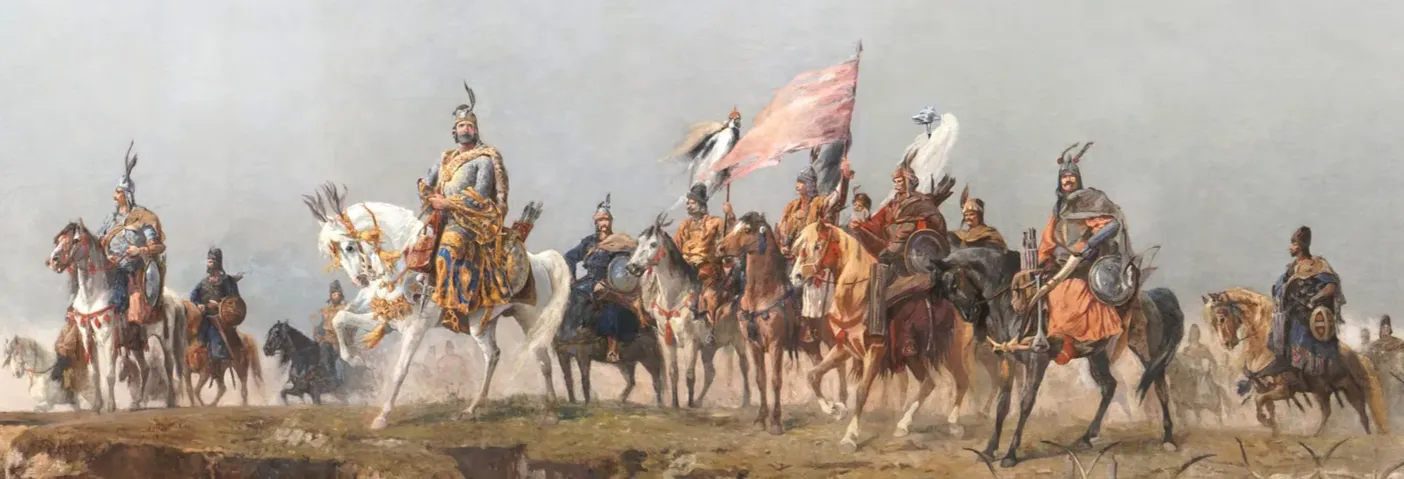
"Arrival of the Hungarians (Árpád Feszty)" by Árpád Feszty / Wikimedia Commons.
The Magyars were a nomadic people who traveled westward from the Eurasian steppes into Europe during the late ninth century. By 895 CE, the Magyars had crossed the Carpathian Mountains and began settling in the region now known as Hungary. Their arrival marked a major change in European history, as these skilled horsemen soon became famous for their swift and daring raids across Central and Western Europe.
The core strength of the Magyars was their mastery of cavalry tactics. They rode small but fast horses and used recurved bows to attack at high speed. Contemporary sources, such as the Annals of Fulda from the early 900s, describe how Magyar horsemen could appear suddenly, strike with arrows, and disappear before defenders could respond. Archaeological finds, including burial mounds with horse bones and weapons, support these accounts. The Magyars launched raids as far as northern Italy, Germany, and even the outskirts of Paris between 900 and 955 CE. These attacks caused panic among European rulers and forced kingdoms to strengthen their defenses. The construction of stone fortresses and new military alliances were direct responses to the Magyar threat.
Although the Magyars were feared as raiders, they were also influenced by the cultures they encountered. Over time, they adopted Christianity and new forms of government. A turning point came in 955 CE at the Battle of Lechfeld, where German King Otto I defeated the Magyars near Augsburg. This loss ended their large-scale raids into western Europe. Afterward, the Magyars began to settle permanently in the Carpathian Basin. Under their leader, Grand Prince Géza, and later his son Stephen I, the Magyars created the Kingdom of Hungary in the year 1000. They built towns, established laws, and became part of European society.
The Magyar settlement in Hungary had lasting effects. Their culture blended with Slavic, Germanic, and Latin influences in the region. Hungary became an important kingdom in medieval Europe and a bridge between the East and West. The Magyars’ story shows how migration, warfare, and adaptation shaped the map of Europe. Today, the Hungarian language and identity are living legacies of these once-nomadic raiders.
The movements and actions of the Magyars connect to larger themes of world history, such as migration, cultural exchange, and the rise and fall of empires.
Interesting Fact: Some medieval chronicles claim the Magyars could ride for days without stopping, thanks to their strong horses and survival skills.
Comprehension quiz (8 questions)
1. Where did the Magyars originally come from?
2. What year did the Magyars settle in Hungary?
3. Who defeated the Magyars at Lechfeld?
4. Why did European kingdoms build stone fortresses?
5. How did the Magyars' defeat change them?
6. What was a main strength of the Magyars?
7. The Magyars spoke French. True or false?
8. What does 'migration' mean?
Perfect for the way you teach
- Build comprehension skills
- Auto-graded quiz
- Differentiated reading
- Read together at home
- Improve fluency
- Quiet reading time
- Reading curriculum support
- Independent practice
- Track Lexile growth