Medieval Church
Interactive passage with audio narration, comprehension questions, and printable PDF.
By completing this purchase you agree to our Terms of Use and Privacy Policy. Your subscription renews automatically until you cancel. You can cancel anytime from your account settings. All sales are final and non-refundable. Digital content is available for download in your account immediately upon purchase.
What's included
Medieval Church preview and details
About this printable Medieval Church reading passage (Grades 5-8)
Sample passage and quiz from Medieval Church
Reading passage and comprehension quiz preview
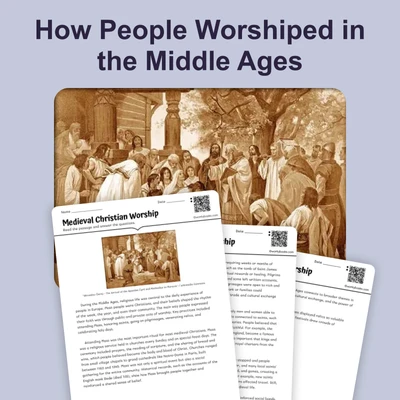
Medieval Catholic Church

Ruins of the medieval Catholic church of Arač" by Sors bona / Wikimedia Commons
During the Middle Ages, the Catholic Church became one of the most powerful forces in Europe. After the fall of the Roman Empire in the 5th century, Europe was divided into many kingdoms and regions, each with its own rulers and laws. In this time of uncertainty, the Church provided a sense of order and unity that connected people across borders.
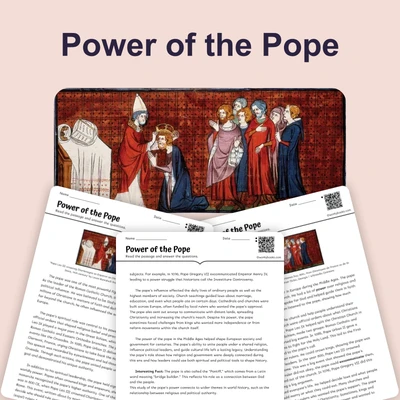
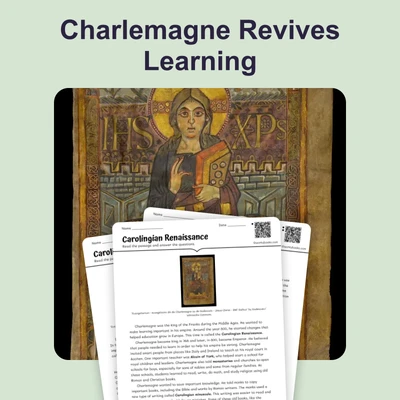
The Church’s influence reached nearly every aspect of life. The Pope, who was the leader of the Catholic Church, held spiritual authority over Christians throughout Europe. Important events, such as the crowning of Charlemagne as Holy Roman Emperor by Pope Leo III in 800 CE, showed the Church’s role in government and politics. The Church established a network of monasteries and cathedrals that became centers of worship, learning, and community gatherings. In places like Canterbury Cathedral in England or Notre Dame in Paris, people came together for religious ceremonies and festivals.
Education was one of the Church’s greatest contributions to medieval society. Monasteries preserved ancient texts and created new ones by copying manuscripts by hand. Monks acted as teachers, and many children—especially those from noble families—learned to read and write in Latin, the language of the Church. The first universities, such as those in Bologna and Paris, grew out of Church schools and taught subjects like philosophy, theology, and law. These efforts helped keep knowledge alive during a time when few people outside the Church could read or write.
The Church also shaped the identity and daily life of medieval Europeans. Shared beliefs, rituals, and holidays gave people a sense of belonging, no matter which kingdom they lived in. Every week, villagers attended mass, celebrated holy days, and followed the Church’s calendar. The Church provided charity for the poor, cared for the sick in hospitals, and helped resolve disputes through canon law, its own legal system. Although some local customs remained, the Church’s teachings influenced art, music, and even how people viewed the world. Archaeological evidence, such as decorated churches and illuminated manuscripts, shows the deep impact of faith on medieval culture.
Over time, the Church’s power both brought people together and created challenges. Sometimes, Church leaders disagreed with kings, leading to conflicts like the dispute between Pope Gregory VII and Emperor Henry IV in the 11th century. Yet, the Church’s ability to unite so many different peoples made it a lasting symbol of shared European identity.
The story of the Catholic Church in medieval Europe helps us understand how religion can shape societies and provide unity in times of change. It also connects to broader themes of cultural exchange, education, and the development of communities across world history.
Interesting Fact: The word "university" comes from the Latin "universitas," meaning a community of teachers and scholars—a tradition started by the Church.
Comprehension quiz (8 questions)
1. Who was crowned emperor by Pope Leo III?
2. What was the Church’s own legal system called?
3. Where was a famous medieval cathedral mentioned?
4. Why did the Church build monasteries?
5. How did Church schools help medieval society?
6. What effect did the Church’s calendar have?
7. The Church united Europe across many kingdoms.
8. What is a cathedral?
Perfect for the way you teach
- Build comprehension skills
- Auto-graded quiz
- Differentiated reading
- Read together at home
- Improve fluency
- Quiet reading time
- Reading curriculum support
- Independent practice
- Track Lexile growth