Reading Passage

Medieval Market Days

Interactive passage with audio narration, comprehension questions, and printable PDF.

No ratings yet
Grades 5–8ReadingElaSocial-studiesHistoryEnglish · SpanishInteractive · Printable

What's included

Reading passage
Audio narration
Comprehension quiz
Writing activity
Glossary & flashcards
Differentiated version
Spanish translation

Medieval Market Days preview and details

About this printable Medieval Market Days reading passage (Grades 5-8)

This engaging history reading passage explores the lively weekly markets of Medieval Europe, highlighting their economic and social significance. Students learn how market days transformed town squares into bustling centers where merchants, farmers, and townspeople exchanged goods, shared news, and shaped the local economy. The passage explains the structure of medieval markets, the variety of goods sold, the role of traveling merchants, and the influence of geography on trade. Key academic vocabulary is woven throughout, and the passage includes primary source references and archaeological findings. This resource aligns with CA HSS 7.2.2 and CCSS RH.6-8.2, and includes a Spanish translation, read aloud audio, and multiple activities to help students analyze cause and effect, understand trade networks, and connect economic developments to broader historical themes.
Written by Workybooks TeamPublished by Workybooks
Preview

Sample passage and quiz from Medieval Market Days

Reading passage and comprehension quiz preview

Medieval Market Days
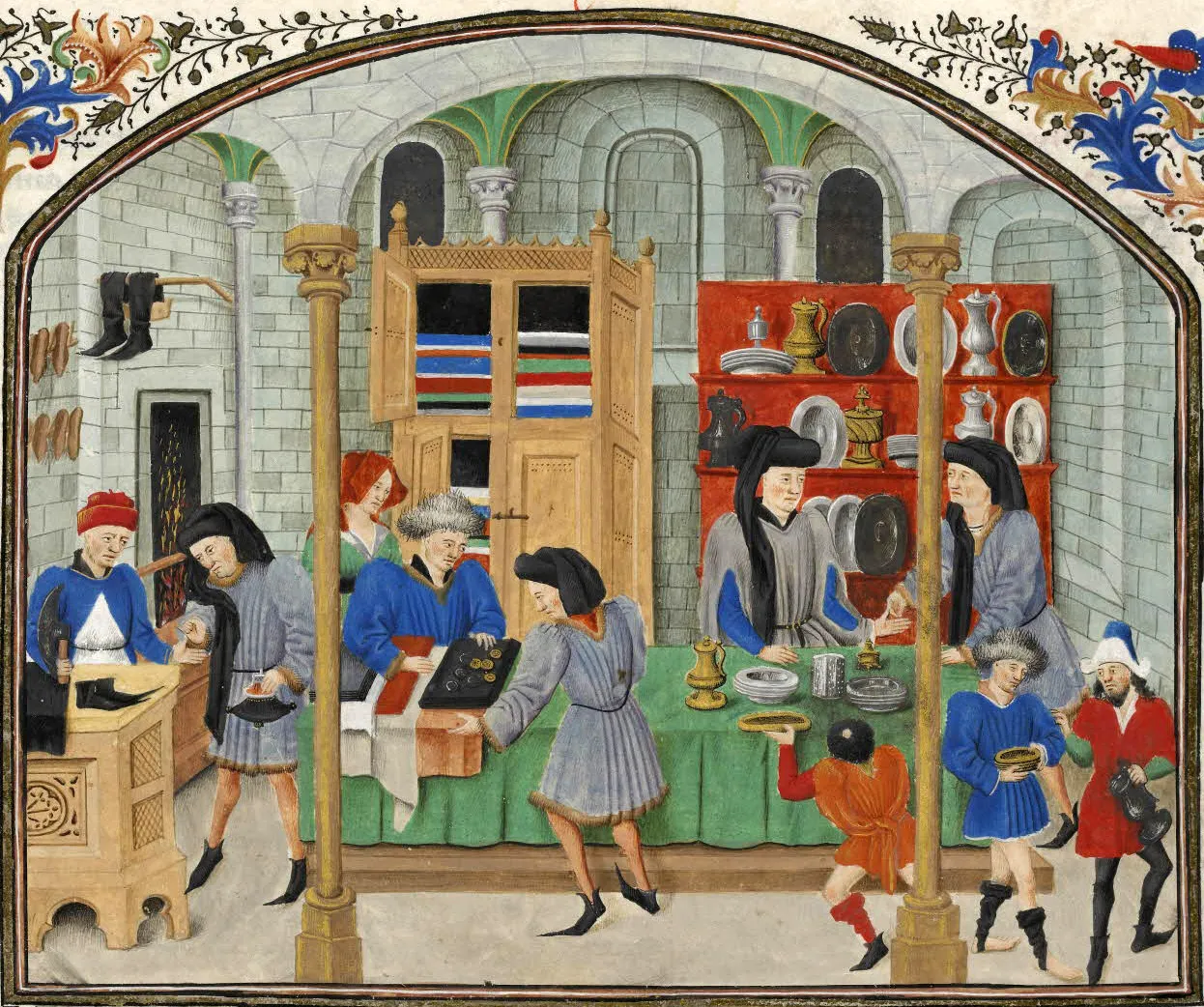
Medieval market

"Medieval market" by Nicole Oresme / Wikimedia Commons.

Medieval market days were a central part of life in European towns between the 11th and 15th centuries. Every week, town squares across England, France, and the Holy Roman Empire filled with people eager to buy, sell, and trade. These markets were more than just places to shop—they were vital to the economy, social life, and even the growth of cities. Written records from towns like Winchester in England show that markets were held as early as 1136, and archaeological finds such as old coins and pottery shards confirm their popularity.

The main event took place in the town square, which was usually located near important buildings like the church or town hall. Merchants arrived early to set up their stalls, many of which were simple wooden tables covered with cloth. Goods for sale included fresh vegetables, bread, cheese, cloth, and tools. Some items, such as spices, silk, and salt, came from distant places, showing the trade routes that connected different regions. These traveling merchants, called "chapmen" in England, often journeyed for weeks to reach the markets, bringing exotic products and news from faraway lands.

During market days, the square bustled with activity. Local farmers and craftsmen displayed their work, while townspeople haggled over prices. There were rules for fair trading, often set by the local lord or town council, and sometimes the guilds—groups of skilled workers—helped maintain order. In some places, such as the city of Cologne in Germany, the right to hold a market was a special privilege granted by a king or emperor. Markets were also places for entertainment, with musicians, jugglers, and even traveling doctors attracting crowds.

The economic importance of markets cannot be overstated. They allowed people to get goods they could not produce themselves and encouraged the rise of a middle class made up of merchants and skilled workers. Over time, successful markets led to the growth of towns into larger cities. However, not everything was peaceful—sometimes disputes over pricing or quality led to quarrels, and theft was a concern. Despite these challenges, market days continued for centuries, shaping the economic and social structure of Medieval Europe.

Medieval market days reveal how geography, trade, and daily life were deeply connected. The tradition of weekly markets continues in many European towns today, showing the lasting impact of these gatherings.

Interesting Fact: Some medieval markets had official "weighers" to make sure merchants used honest weights and did not cheat customers.

Comprehension quiz (8 questions)

1. When did market days take place?

Weekly
Monthly
Yearly
Only at harvest

2. Which city in England had early markets?

Winchester
London
York
Paris

3. What did traveling merchants bring?

Exotic goods
Farm animals
Horses
Weapons

4. Why were guilds important?

Maintained order
Sold bread
Built churches
Hired jugglers

5. How did markets help towns grow?

Attracted people and trade
Built castles
Started wars
Planted trees

6. What is a 'middle class'?

Merchants and skilled workers
Kings and knights
Peasants only
Priests and nobles

7. Markets only sold food. (True/False)

False
True

8. What does 'archaeological' mean?

Study of old objects
Making bread
Trading goods
Building roads
Who it's for

Perfect for the way you teach

Teachers
  • Build comprehension skills
  • Auto-graded quiz
  • Differentiated reading
Parents
  • Read together at home
  • Improve fluency
  • Quiet reading time
Homeschoolers
  • Reading curriculum support
  • Independent practice
  • Track Lexile growth
Topics

Reviews & Ratings

No reviews yet. Be the first to share your experience!

More reading you might love

20 more
Passage
Middle Ages Legacy - reading educational content

Middle Ages Legacy

Reading Passage

$1.50
Passage
Early Middle Ages - reading educational content

Early Middle Ages

Reading Passage

$1.50
Passage
High Middle Ages - reading educational content

High Middle Ages

Reading Passage

$1.50
Passage
What Were the Middle Ages? - reading educational content

What Were the Middle Ages?

Reading Passage

$1.50
Passage
Late Middle Ages - reading educational content

Late Middle Ages

Reading Passage

$1.50
Passage
Dark Ages - reading educational content

Dark Ages

Reading Passage

$1.50
Passage
Life in Middle Ages - reading educational content

Life in Middle Ages

Reading Passage

$1.50
Passage
Medieval Islamic World - reading educational content

Medieval Islamic World

Reading Passage

$1.50
Passage
Women's Roles in the Middle Ages - reading educational content

Women's Roles in the Middle Ages

Reading Passage · HSS 7.6.1

$1.50
Passage
Islamic Golden Age - reading educational content

Islamic Golden Age

Reading Passage

$1.50
Passage
Medieval to Modern Transition - reading educational content

Medieval to Modern Transition

Reading Passage

$1.50
Passage
Medieval Words in English - reading educational content

Medieval Words in English

Reading Passage

$1.50
Passage
Age of Exploration Begins - reading educational content

Age of Exploration Begins

Reading Passage

$1.50
Passage
Italian City-States - reading educational content

Italian City-States

Reading Passage

$1.50
Passage
Attila the Hun - reading educational content

Attila the Hun

Reading Passage

$1.50
Passage
Medieval Guilds - reading educational content

Medieval Guilds

Reading Passage

$1.50
Passage
Medieval Christian Worship - reading educational content

Medieval Christian Worship

Reading Passage

$1.50
Passage
Power of the Pope - reading educational content

Power of the Pope

Reading Passage

$1.50
Passage
Carolingian Renaissance - reading educational content

Carolingian Renaissance

Reading Passage

$1.50
Passage
Islamic Golden Age Inventions - reading educational content

Islamic Golden Age Inventions

Reading Passage

$1.50
Copyright © 2026 Workybooks. Made with ♥ in California.