Medieval Money and Banking
Interactive passage with audio narration, comprehension questions, and printable PDF.
By completing this purchase you agree to our Terms of Use and Privacy Policy. Your subscription renews automatically until you cancel. You can cancel anytime from your account settings. All sales are final and non-refundable. Digital content is available for download in your account immediately upon purchase.
What's included
Medieval Money and Banking preview and details
About this printable Medieval Money and Banking reading passage (Grades 5-8)
Sample passage and quiz from Medieval Money and Banking
Reading passage and comprehension quiz preview
Medieval Money and Banking
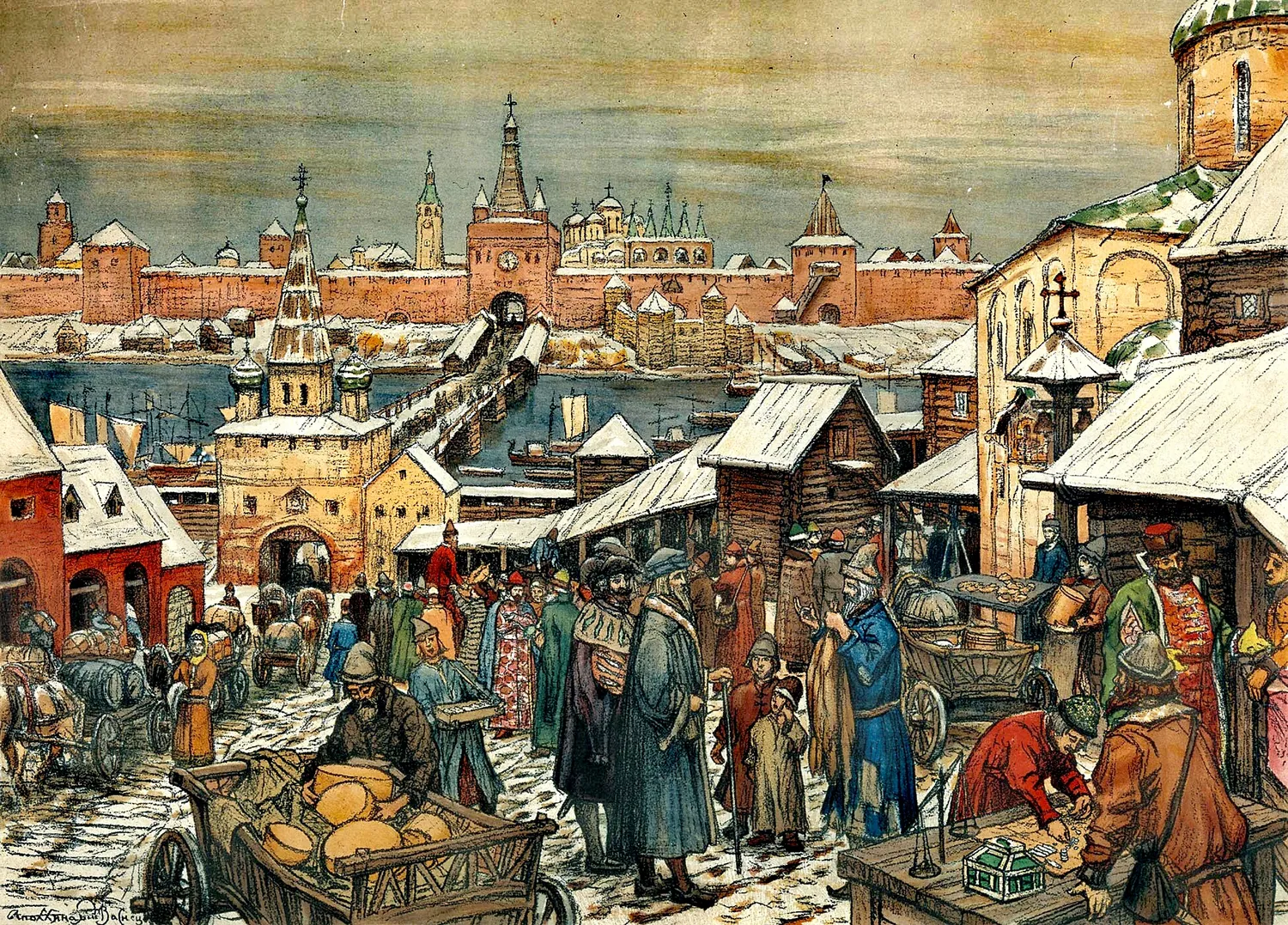
"Novgorod torg" by Apollinary Vasnetsov / Wikimedia Commons.
During the Middle Ages in Europe, the way people exchanged goods and services changed dramatically as societies moved from barter to using coins and early banking systems. This transformation affected daily life, social classes, and even the power of cities like Florence and Venice. Understanding medieval money and banking helps us see how economic ideas and practices developed over time.
Before the rise of money, most trade in Europe relied on barter. People exchanged items such as grain, livestock, or cloth directly, without money. However, barter was often inconvenient. For example, a farmer who had grain might want shoes, but if the shoemaker did not need grain, trade became difficult. Archaeological finds, like remnants of ancient markets, show that barter was common across early medieval villages. Over time, rulers began to mint metal coins, making trade easier. By the 8th and 9th centuries, silver pennies were used in England, while gold coins like the florin appeared in Florence in the 13th century. Coins provided a standard value and were easier to carry and count than sacks of goods.
The rise of cities and long-distance trade in the 12th and 13th centuries led to new economic needs. Merchants traveled between regions, exchanging wool, spices, and silk. Carrying large amounts of coins was risky, so money-lending and early forms of banking developed, especially in Italian city-states. In Florence, the Medici family created one of the most powerful banks by the 15th century, using letters of credit and ledgers to keep track of money. Documents from the Riccardi Bank of Lucca, dated to the late 1200s, show how merchants deposited funds and borrowed money to invest in trade. These systems allowed merchants to travel with less cash, reducing the risk of theft and helping wealth grow.
Banking also changed the social structure. Merchants and bankers grew wealthy and influential, sometimes even more than nobles. City-states like Venice, Genoa, and Florence became economic centers, attracting skilled workers and artists. Banking families, such as the Medicis, used their wealth to finance public buildings and art, shaping the culture of the Renaissance. However, not everyone benefited equally. Poor farmers and workers often lacked access to banks, and money-lending was sometimes controversial due to religious beliefs about usury, or charging interest on loans.
The development of money and banking in the Middle Ages marked a turning point in European history. The shift from barter to coins and banks made trade easier, supported the growth of cities, and helped new social classes gain power. These economic changes laid the groundwork for modern banking and capitalism, connecting medieval Europe to global trade networks.
This topic connects to broader themes of world history, such as the development of economies, the impact of geography on trade, and the changing roles of social groups over time.
Interesting Fact: Medieval bankers in Florence invented double-entry bookkeeping, a system still used by businesses today to track money accurately.
Comprehension quiz (8 questions)
1. What replaced barter in medieval Europe?
2. Where was the florin first minted?
3. Who became wealthy from medieval banking?
4. Why did merchants use banks?
5. What is usury?
6. How did banking affect social structure?
7. Florin coins were made of gold. True or false?
8. What does 'barter' mean?
Perfect for the way you teach
- Build comprehension skills
- Auto-graded quiz
- Differentiated reading
- Read together at home
- Improve fluency
- Quiet reading time
- Reading curriculum support
- Independent practice
- Track Lexile growth