Medieval Population Growth
Interactive passage with audio narration, comprehension questions, and printable PDF.
By completing this purchase you agree to our Terms of Use and Privacy Policy. Your subscription renews automatically until you cancel. You can cancel anytime from your account settings. All sales are final and non-refundable. Digital content is available for download in your account immediately upon purchase.
What's included
Medieval Population Growth preview and details
About this printable Medieval Population Growth reading passage (Grades 5-8)
Sample passage and quiz from Medieval Population Growth
Reading passage and comprehension quiz preview
Europe's Population Boom
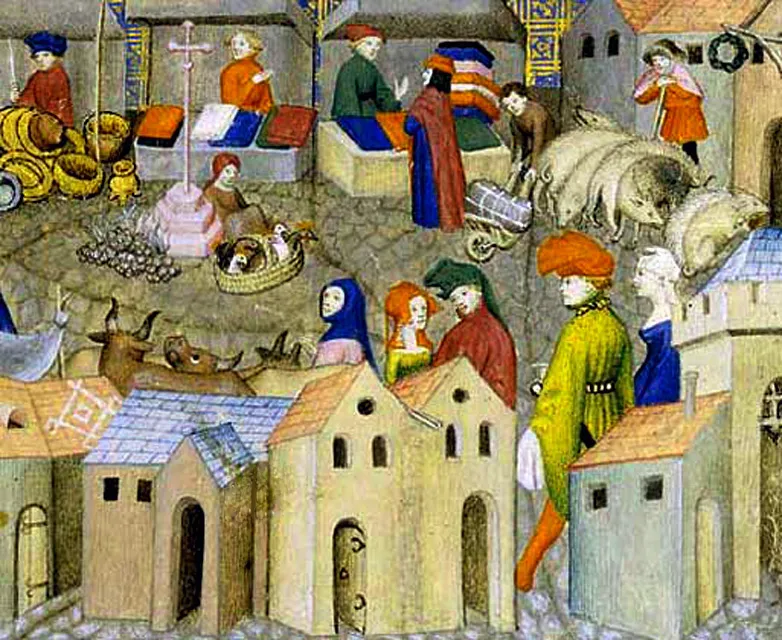
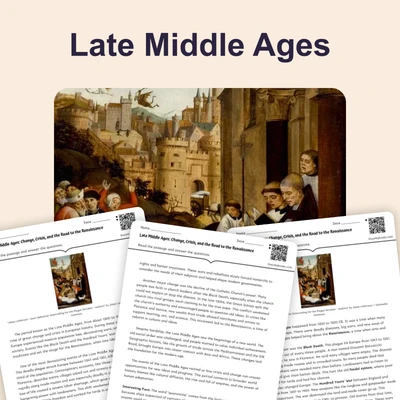
"Scène de foire" by Workshop of Master of the City of Ladies / Wikimedia Commons.
After 1000 CE, Europe experienced a dramatic increase in population, leading historians to call this time a “population boom.” Several key factors contributed to this transformation in medieval society. These included improvements in agriculture, a period of warmer climate, and greater peace. Together, these changes allowed more people to survive and thrive than ever before.
One of the main causes of population growth was the development of new farming techniques. Farmers began to use the three-field system, which divided land into three sections: one for spring crops, one for autumn crops, and one left fallow to rest. This method increased food production, so more food was available to feed more people. The invention of the heavy plow and the use of horses with special harnesses also made it easier to cultivate tough northern European soils. Archaeological evidence, such as iron plowshares found in England and France, shows how technology advanced during this period. Written records from monasteries mention increased grain harvests in the 11th and 12th centuries.
Another important factor was the change in climate during this era, often called the Medieval Warm Period. Between about 950 and 1250 CE, Europe’s weather became milder and wetter. This allowed for longer growing seasons and richer harvests. Chronicles from the time, like the Anglo-Saxon Chronicle, report years of good harvests and mild winters. With more reliable food supplies, people could marry earlier and have more children. The population of places like France and the Holy Roman Empire nearly doubled between 1000 and 1300 CE.
Peace and stability also played a crucial role. Before 1000 CE, Europe was often troubled by invasions and local wars. Afterward, powerful kings and the Catholic Church helped keep order. The “Peace of God” and “Truce of God” movements encouraged nobles to stop fighting each other and protect peasants. As safety increased, towns grew and trade spread. Cities like Paris and London expanded, and many people moved from rural villages to urban centers, seeking new opportunities. Social hierarchies shifted as merchants and townspeople gained more influence.
The population boom of medieval Europe had lasting effects. Greater numbers of people meant that cities, trade, and culture flourished. However, it also brought challenges: crowded towns could be unhealthy, and poor harvests sometimes led to famine. Still, the changes after 1000 CE laid the foundation for further growth and innovation in the centuries to come.
This period connects to larger world history themes, such as the impact of technological and environmental change on societies. By understanding Europe’s population boom, we can see how human choices and natural conditions shape the course of history.
Interesting Fact: In the 13th century, some medieval towns like Venice and Paris may have had over 100,000 people—making them among the largest cities in Europe at the time.
Comprehension quiz (8 questions)
1. What system improved medieval farming?
2. When did Europe’s population boom start?
3. Which cities grew rapidly during this period?
4. What was one effect of better farming?
5. How did the climate change after 950 CE?
6. Why did towns sometimes become unhealthy?
7. Europe’s population almost doubled by 1300 CE. True or false?
8. What does famine mean?
Perfect for the way you teach
- Build comprehension skills
- Auto-graded quiz
- Differentiated reading
- Read together at home
- Improve fluency
- Quiet reading time
- Reading curriculum support
- Independent practice
- Track Lexile growth