This learning resource is available in interactive and printable formats. The interactive worksheet can be played online and assigned to students. The Printable PDF version can be downloaded and printed for completion by hand.
This comprehensive middle school science passage explores the widely accepted giant impact hypothesis for the Moon’s origin, aligned to NGSS standard MS-ESS1-2. Students will learn how a collision between early Earth and a Mars-sized object (Theia) led to the Moon’s formation from debris. The passage details the scientific evidence, including lunar rock composition and computer simulations, and discusses why rival theories are rejected. Real-world implications connect the Moon’s formation to understanding Earth's geological history. Key academic vocabulary is highlighted and defined. The resource includes a Spanish translation, a leveled version for struggling readers, and multiple activities—such as quizzes, writing prompts, and graphic organizers—to build analytical and scientific reasoning skills. This passage is ideal for science classrooms and is audio integrated for accessibility.
The Moon is the brightest object in our night sky, but for centuries, scientists wondered how it came to be. Today, the most widely accepted explanation is the Giant Impact Hypothesis. This theory describes a dramatic collision that happened about 4.5 billion years ago, soon after Earth formed. Understanding how the Moon formed is important because it gives us clues about the early history of our planet and the entire solar system.
How the Moon Formed: The Giant Impact Hypothesis
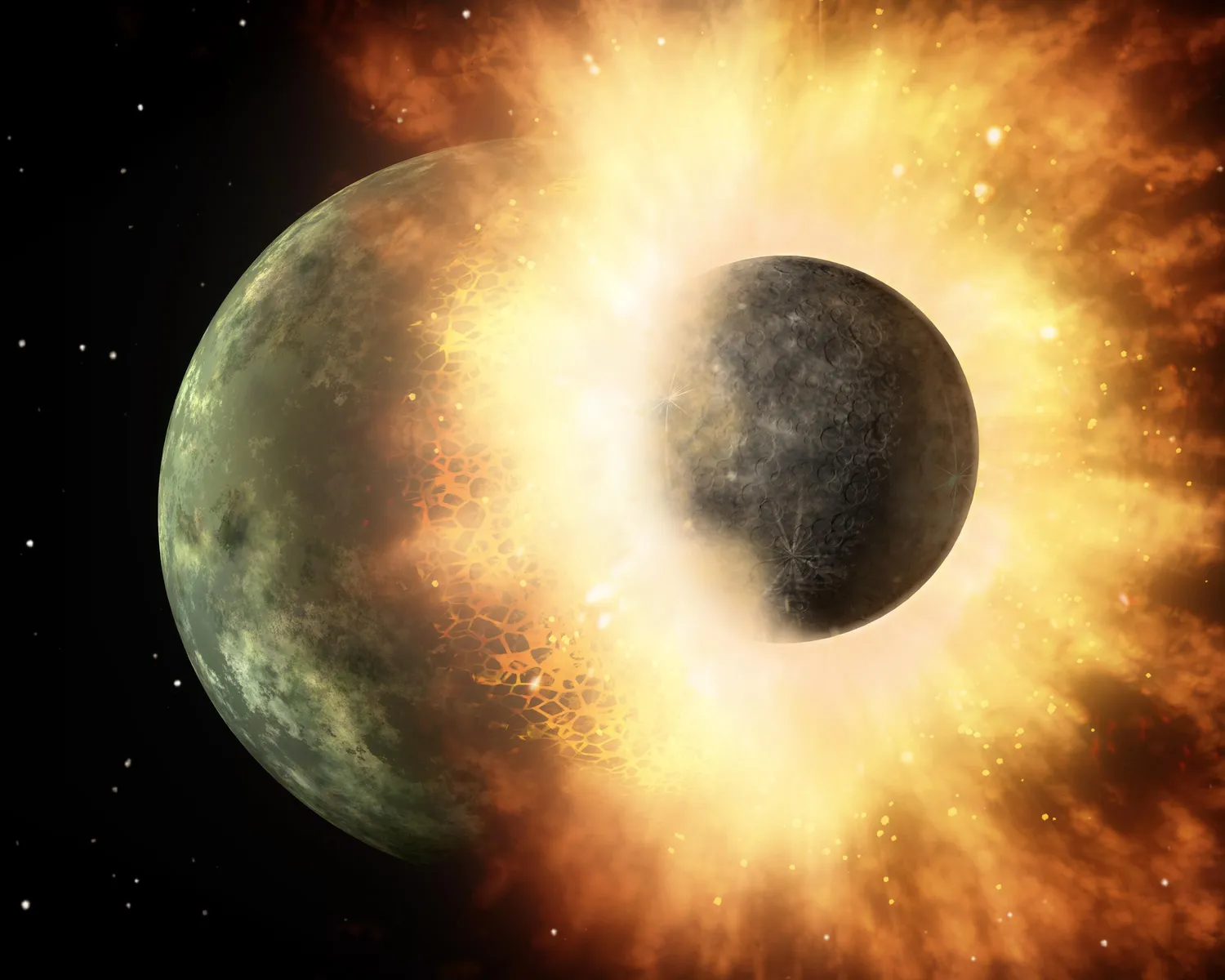
According to the Giant Impact Hypothesis, a Mars-sized object called Theia struck the early Earth with immense force. The impact was so powerful that it vaporized part of Earth’s outer layer and Theia itself, blasting huge amounts of rock and metal into orbit around Earth. This debris formed a swirling disk of hot, melted rock. Over time, gravity pulled the material together, causing it to cool and clump into a single large body—the Moon. Scientists estimate this entire process took only a few thousand years, a very short time in the history of the solar system.
Evidence for the Giant Impact Hypothesis
Several lines of evidence support this idea. First, rocks brought back from the Moon by astronauts have a chemical composition similar to Earth’s mantle, the layer beneath Earth’s crust. This suggests the Moon formed from material that once belonged to Earth. Second, the Moon has a much smaller iron core compared to Earth. If the Moon had formed elsewhere or split off from Earth, its core would likely be larger. Third, advanced computer simulations show that a giant collision could produce a Moon with the size and orbit we observe today. Finally, compared to other planets, Earth’s Moon is unusually large for a satellite, which matches what would be expected from a giant impact event.
Rejected Theories and Scientific Implications
Other theories have been proposed, but they do not fit the evidence as well. The capture theory suggests the Moon formed elsewhere and was pulled in by Earth’s gravity, but this cannot explain the Moon’s similar composition to Earth. The co-formation theory states that Earth and the Moon formed together from the same disk, but this theory does not account for the differences in their cores. The fission theory suggests the Moon split off from a rapidly spinning Earth, but the physics do not work out. By understanding the true origin of the Moon, scientists also learn about Earth’s early atmosphere, volcanic activity, and even the conditions needed for life.
In summary, the Giant Impact Hypothesis best explains the Moon’s origin using evidence from rocks, computer models, and comparisons with other planets. Studying the Moon’s formation helps scientists understand not just our own planet, but also how planets and moons form throughout the universe.
Interesting Fact: The Moon is slowly moving away from Earth at a rate of about 3.8 centimeters per year, changing the length of our days over millions of years.
What is the most widely accepted explanation for the Moon’s origin?
The Giant Impact HypothesisThe Capture TheoryThe Co-formation TheoryThe Fission Theory
About how long ago did the event that formed the Moon happen?
4.5 billion years ago500 million years ago2 million years ago10,000 years ago
Which object collided with early Earth to help form the Moon?
TheiaEuropaVenusTitan
What main evidence supports the Giant Impact Hypothesis?
Moon rocks are similar to Earth's mantleThe Moon is made of gasThe Moon has a giant iron coreThe Moon is smaller than most moons
In the passage, what does the word 'gravity' mean?
The force that pulls objects toward each otherA type of rockA spinning motionA metal found on Earth
What does 'mantle' refer to in the passage?
The layer of rock beneath Earth's crustEarth's outermost atmosphereA ring of debrisA type of planet
Why is the co-formation theory rejected?
It does not explain the different cores of Earth and MoonIt suggests the Moon formed from gasIt shows the Moon is older than EarthIt does not mention gravity
Which of the following is an effect of the Moon moving away from Earth?
The length of Earth's days changes over millions of yearsThe Moon becomes smallerEarth spins slower every dayThe Moon gets closer to the Sun
True or False: The Moon is unusually large compared to other planetary satellites.
TrueFalse
True or False: The capture theory is the best explanation for the Moon’s origin.
FalseTrue
Perfect For:
👩🏫 Teachers
• Reading comprehension practice
• Auto-graded assessments
• Literacy skill development
👨👩👧👦 Parents
• Reading practice at home
• Comprehension improvement
• Educational reading time
🏠 Homeschoolers
• Reading curriculum support
• Independent reading practice
• Progress monitoring
Reading Features:
📖
Reading Passage
Engaging fiction or nonfiction text
❓
Comprehension Quiz
Auto-graded questions
📊
Instant Feedback
Immediate results and scoring
📄
Printable Version
Download for offline reading
🔊
Read Aloud
Voice-over with word highlighting
Reviews & Ratings
No reviews yet. Be the first to share your experience!
Related Content
Comets
This middle school science passage explores the fascinating world of comets, commonly known as 'dirty snowballs.' Studen...
MS-ESS1-2
Mercury: Closest to the Sun
This comprehensive, standards-aligned passage explores Mercury—the smallest and closest planet to the Sun. Students in g...
MS-ESS1-2MS-ESS1-3
Venus: Earth's Twin?
This comprehensive science passage for grades 6-8 examines Venus—often called Earth's twin—by exploring its similarities...
MS-ESS1-2MS-ESS1-3
Earth: Our Home Planet
This comprehensive science passage for grades 6-8 explores Earth’s unique characteristics and the interconnected systems...
MS-ESS1-2
Mars: The Red Planet
This middle school science passage explores Mars, the Red Planet, providing students in grades 6-8 with a comprehensive ...
MS-ESS1-2MS-ESS1-3
What Is Gravity?
This comprehensive middle school science reading passage explores the concept of gravity, aligning with NGSS standards M...
MS-ESS1-2MS-PS2-4
Kepler's Laws of Planetary Motion
This comprehensive middle school science passage explores Kepler's Laws of Planetary Motion, meeting NGSS Standard MS-ES...
MS-ESS1-2
Tides and Tidal Forces
This middle school science passage explores the mechanisms of tides and tidal forces, aligning with NGSS standards MS-ES...
MS-ESS1-1MS-ESS1-2
Escape Velocity and Space Travel
This middle school science passage introduces students to the concept of escape velocity—the minimum speed required to b...
MS-ESS1-2MS-PS2-4
Weightlessness and Microgravity
This science reading passage for middle school students explores the phenomenon of weightlessness and microgravity. Alig...
MS-PS2-4MS-ESS1-2
Orbits and Orbital Motion
This middle school science passage, aligned with NGSS MS-ESS1-2 and MS-PS2-4, explores the science of orbits and orbital...
MS-ESS1-2MS-PS2-4
What Is the Solar System?
This passage provides a comprehensive overview of the solar system for grades 6-8, aligned with NGSS standards MS-ESS1-2...
MS-ESS1-2MS-ESS1-3
Structure of the Solar System
This comprehensive science reading passage introduces middle school students (grades 6-8) to the structure of the solar ...
MS-ESS1-2MS-ESS1-3
Moons of the Solar System
This comprehensive passage, designed for grades 6-8 and aligned to NGSS standard MS-ESS1-2, delves into the fascinating ...
MS-ESS1-2
Defining Life: What Are We Looking For?
This informational science passage for middle school students explores the question: What is life, and how do we define ...
MS-LS1-1MS-ESS1-2
Astronomy
This comprehensive reading passage introduces middle school students to the science of astronomy, which is the study of ...
MS-ESS1-2MS-ESS1-3MS-PS4-2MS-ETS1-1
The Solar System
This middle school science passage introduces students to the solar system, aligning with NGSS standards MS-ESS1-2 and M...
MS-ESS1-2MS-ESS1-3
Gravity and Orbits
This comprehensive passage for grades 6-8 explains the science of gravity and orbits, aligning with NGSS standard MS-ESS...
MS-ESS1-2
The Inner Planets
This comprehensive science passage for grades 6-8 explores the inner (terrestrial) planets of our solar system—Mercury, ...
MS-ESS1-2MS-ESS1-3
The Outer Planets
This engaging science passage for grades 6-8 introduces students to the outer planets—Jupiter, Saturn, Uranus, and Neptu...