Plague of Justinian
Interactive passage with audio narration, comprehension questions, and printable PDF.
By completing this purchase you agree to our Terms of Use and Privacy Policy. Your subscription renews automatically until you cancel. You can cancel anytime from your account settings. All sales are final and non-refundable. Digital content is available for download in your account immediately upon purchase.
What's included
Plague of Justinian preview and details
About this printable Plague of Justinian reading passage (Grades 5-8)
Sample passage and quiz from Plague of Justinian
Reading passage and comprehension quiz preview
Plague of Justinian
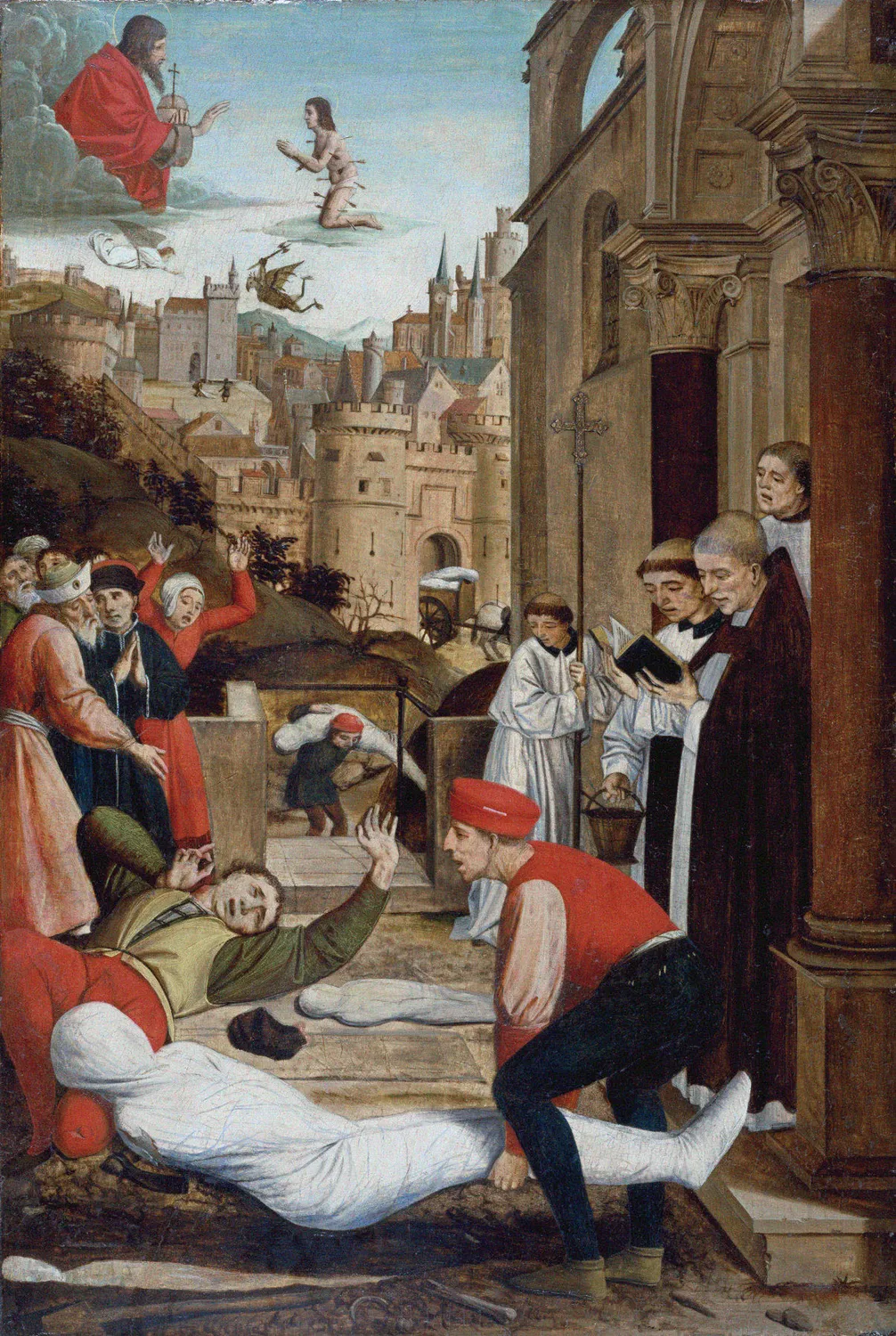
"Josse Lieferinxe - Saint Sebastian Interceding for the Plague Stricken - Walters" by Josse Lieferinxe / Wikimedia Commons.
The outbreak of Justinian's Plague in 541 CE was one of the most devastating events in world history, striking the Byzantine Empire during the reign of Emperor Justinian I. The disease, now believed to be caused by the bacterium Yersinia pestis, spread rapidly from Egypt to the capital city of Constantinople and then across much of Europe, Asia, and North Africa.
The plague first appeared in the port city of Pelusium in Egypt before moving through the busy trade routes of the Mediterranean. Ships carrying grain—and rats infected with fleas—helped the disease spread to Constantinople in 542 CE. Procopius, a historian who lived at the time, described in detail how thousands of people died each day, with bodies piling up in the streets. Archaeological evidence from mass graves in Istanbul supports these accounts, showing a sudden spike in burials during these years.
The impact on society was severe. The death toll is estimated to have reached as high as 25 to 50 million people over several decades, with Constantinople alone losing up to 40% of its population. The urban workforce shrank dramatically, causing economic hardship and food shortages. Farms lay abandoned, and the military struggled to recruit soldiers. The plague weakened the Byzantine Empire’s ability to defend its borders and maintain control over its vast lands. Emperor Justinian himself contracted the disease but survived, although his government was left overwhelmed by the crisis.
Primary sources reveal the daily struggles people faced. Letters and chronicles mention fear, confusion, and the breakdown of social order. Priests and city officials organized mass burials and processions to try to calm the population. The social hierarchy shifted, as many wealthy families died out, allowing others to rise. The government raised taxes to pay for emergency responses, but many citizens could not afford to pay.
Over time, the Byzantine Empire never fully recovered its former strength. The plague reappeared in waves for over 200 years, further weakening the state. Historians argue that the outbreak helped pave the way for later invaders, such as the Arabs and Slavs, to conquer Byzantine territories. The pandemic also changed the demographic and economic landscape of the Mediterranean world, marking a turning point in the Middle Ages.
Today, Justinian’s Plague stands as a powerful example of how epidemics can shape history. It reminds us that disease, geography, and human choices all interact to influence the fate of civilizations.
Interesting Fact: Recent DNA studies from skeletons found in ancient graves have confirmed the presence of Yersinia pestis, the same bacterium that caused the later Black Death.
Comprehension quiz (8 questions)
1. When did Justinian’s Plague begin?
2. Who ruled the Byzantine Empire during the plague?
3. What was the capital city hit by the plague?
4. What caused the plague to spread?
5. How did the plague affect society?
6. Why did the Byzantine Empire weaken?
7. The plague returned many times. True or false?
8. What does 'epidemic' mean?
Perfect for the way you teach
- Build comprehension skills
- Auto-graded quiz
- Differentiated reading
- Read together at home
- Improve fluency
- Quiet reading time
- Reading curriculum support
- Independent practice
- Track Lexile growth