Printing Press Impact
Interactive passage with audio narration, comprehension questions, and printable PDF.
By completing this purchase you agree to our Terms of Use and Privacy Policy. Your subscription renews automatically until you cancel. You can cancel anytime from your account settings. All sales are final and non-refundable. Digital content is available for download in your account immediately upon purchase.
What's included
Printing Press Impact preview and details
About this printable Printing Press Impact reading passage (Grades 5-8)
Sample passage and quiz from Printing Press Impact
Reading passage and comprehension quiz preview
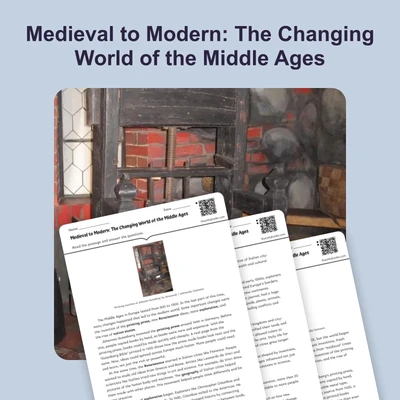
Printing Press Revolution
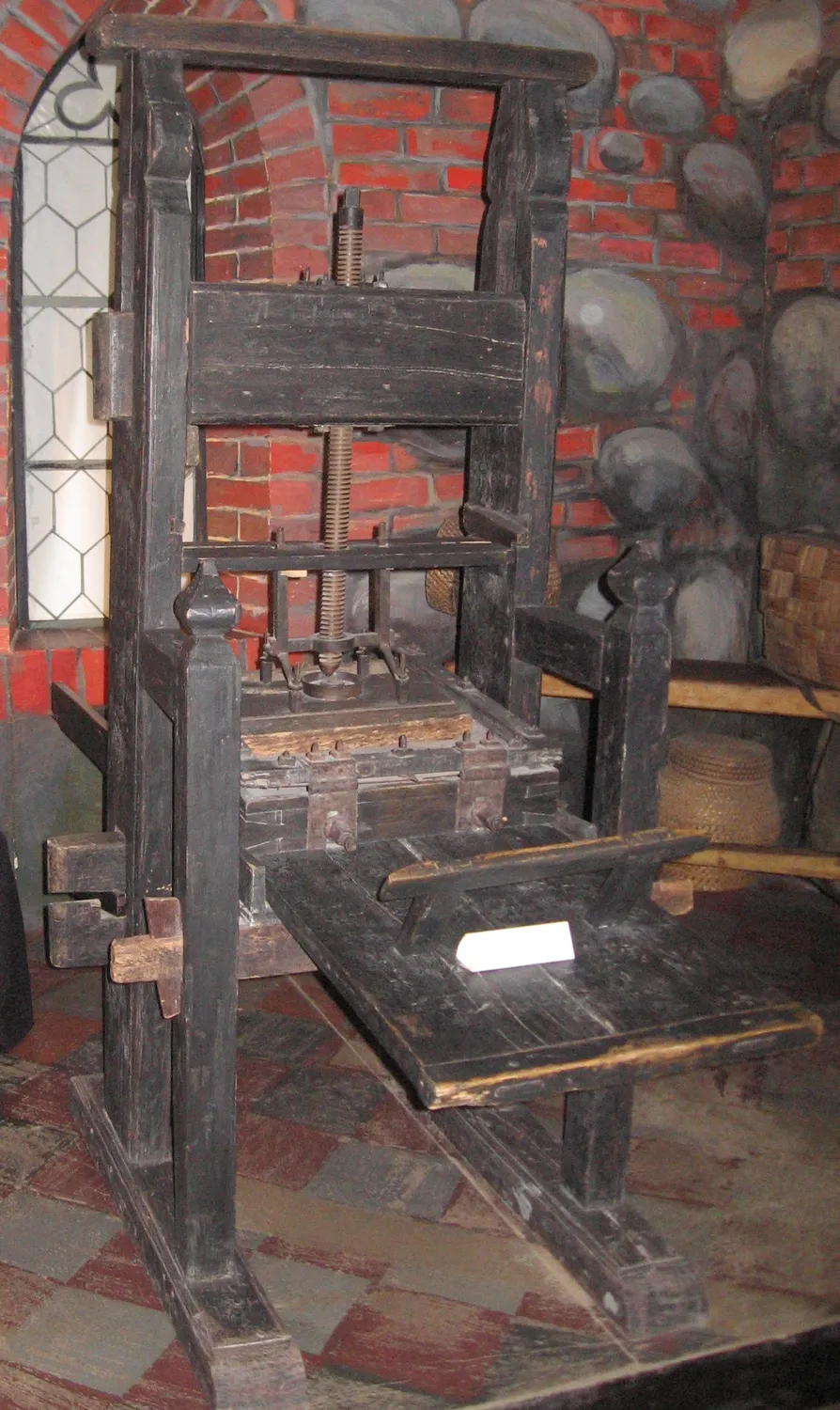
"Printing machine of Johanes Gutenbrg" by Gruszecki / Wikimedia Commons.
The printing press, invented by Johannes Gutenberg in the 1440s in Mainz, Germany, marked a turning point in world history. Before Gutenberg, all books in Europe were copied by hand, a process that was slow, expensive, and often limited to monasteries and wealthy elites. Gutenberg’s innovation introduced a new technology called movable type, which allowed for much faster and more efficient book production.
Gutenberg’s printing press used individual metal letters that could be arranged and rearranged to form words and sentences. Each letter was cast from a mold and set in a frame to create a page of text. After the letters were arranged, they were covered with ink and pressed onto sheets of paper by turning a large screw. This mechanical process meant that a single worker could create hundreds of books in the time it once took to produce just one. A primary source from 1455, a letter by Enea Silvio Piccolomini (later Pope Pius II), describes the excitement over “newly printed Bibles” that were both accurate and beautiful.
The printing press quickly spread across Europe. By 1500, over 1,000 print shops had opened in cities like Venice, Paris, and London. This rapid expansion made books more accessible to people outside the elite classes. Printed materials included not only religious texts but also works of science, law, and literature. For example, the famous Gutenberg Bible—completed around 1455—was the first major book printed using movable type in the West. Archaeological evidence shows that thousands of these early printed books, called incunabula, still survive today.
The social impact of the printing press was enormous. As more people learned to read, ideas spread rapidly across regions. This technological advance helped spark the Renaissance and later the Reformation, as thinkers and reformers could share their writings widely. The press also contributed to changes in social hierarchy, as knowledge was no longer only in the hands of the privileged. However, some leaders feared this new access to information, worrying it might upset established order.
Throughout the Middle Ages and beyond, the printing press changed how people communicated and preserved information. Its legacy continues today, as the mass production of books and newspapers remains vital to modern society. The printing press stands as a prime example of how technology can revolutionize access to knowledge and shape human history.
Interesting Fact: The word "incunabula" comes from Latin and refers to books printed before the year 1501, during the early years of the printing revolution!
Comprehension quiz (8 questions)
1. Who invented the printing press?
2. Where was the printing press invented?
3. What is the Gutenberg Bible?
4. How did movable type help printing?
5. Why did books become more accessible?
6. Which event did the printing press help start?
7. The word 'incunabula' means books printed before 1501.
8. What does 'accessible' mean in the passage?
Perfect for the way you teach
- Build comprehension skills
- Auto-graded quiz
- Differentiated reading
- Read together at home
- Improve fluency
- Quiet reading time
- Reading curriculum support
- Independent practice
- Track Lexile growth