Reading PassagePremium

Renaissance Begins

Interactive passage with audio narration, comprehension questions, and printable PDF.

No ratings yet
Grades 5–8ReadingElaSocial-studiesHistoryEnglish · SpanishInteractive · Printable
Just this resource
$1.50
One-time purchase
Best value
Unlock everything
$49.99$29.99/yr
40% off until Aug 1 — 10,000+ resources
Renews at $49.99/year.
Unlock above to use these actions

What's included

Reading passage
Audio narration
Comprehension quiz
Writing activity
Glossary & flashcards
Differentiated version
Spanish translation

Renaissance Begins preview and details

About this printable Renaissance Begins reading passage (Grades 5-8)

This engaging history reading passage introduces students to the beginning of the Renaissance, a time when Europe shifted from the medieval era to the modern world. The text explores how growing towns, increased trade, and new wealth led to the revival of classical learning and the emergence of humanism. Students will learn about the important role of Italian city-states like Florence, the influence of ancient Greek and Roman texts, and how people’s views on life and learning began to change. The passage includes references to primary sources, key historical terms, and cause-and-effect relationships, making it ideal for building critical reading and analysis skills. With a glossary, differentiated versions, reading comprehension activities, and Spanish translation, this resource meets CA HSS 7.8 and CCSS RI.6-8 standards, and supports diverse learners with accessible content, read-aloud audio, and visual supports.
Written by Workybooks TeamPublished by Workybooks
Preview

Sample passage and quiz from Renaissance Begins

Reading passage and comprehension quiz preview

Renaissance Begins
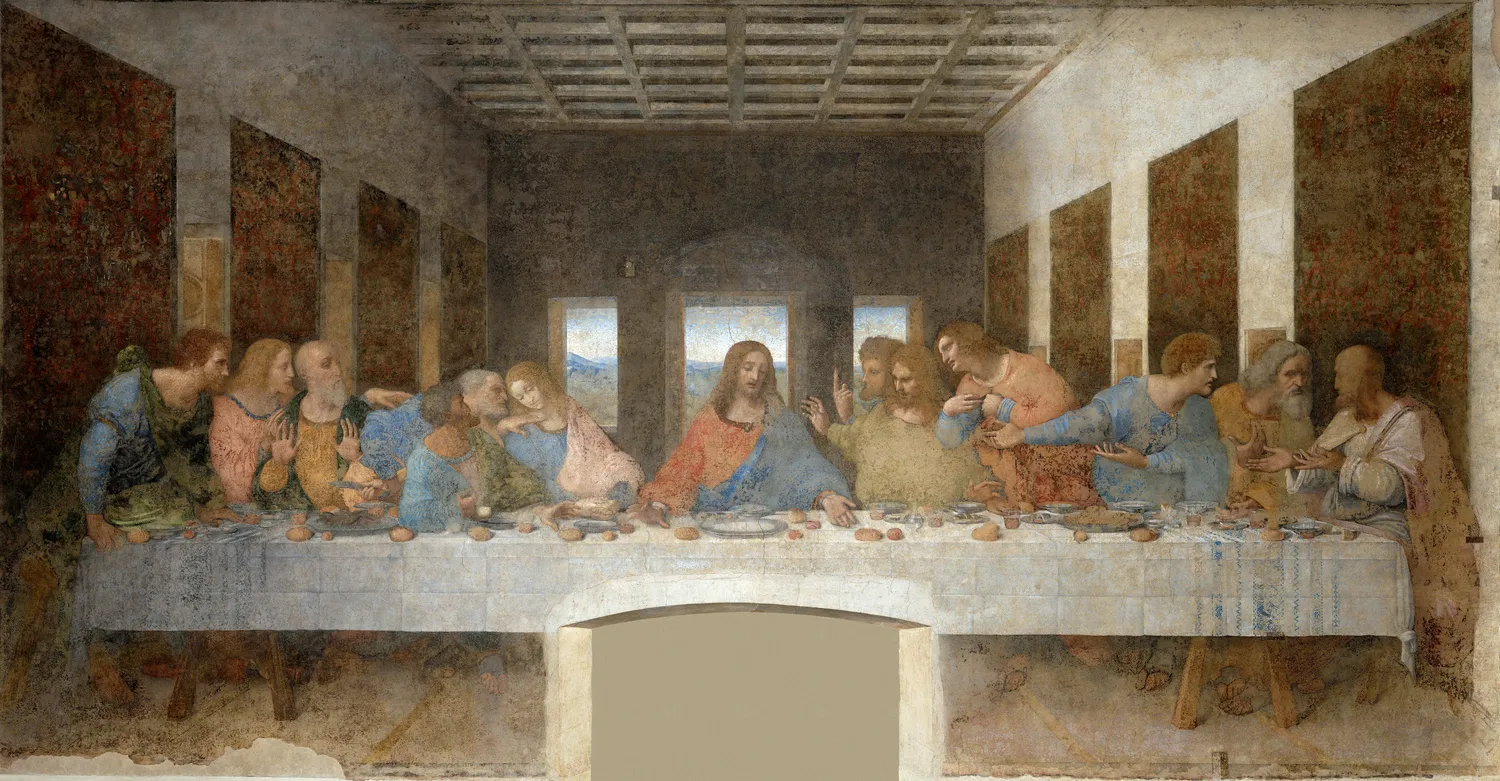
Leonardo da Vinci (1452-1519) - The Last Supper (1495-1498)

"Leonardo da Vinci (1452-1519) - The Last Supper (1495-1498)" by Leonardo da Vinci / Wikimedia Commons.

The Renaissance began in Europe during the 1300s, marking a shift from the Middle Ages to the beginnings of the modern era. This period was defined by the revival of classical learning, the rise of powerful towns, and new ideas about humanity and knowledge.

One of the main reasons for the Renaissance was the growth of towns and city-states in Italy, especially Florence and Venice. As trade increased across the Mediterranean, merchants and bankers became wealthy. For example, the Medici family of Florence used their fortune to support artists and scholars. This new patronage system allowed talented people to focus on art, science, and literature. The busy streets of Florence were filled with markets, workshops, and libraries where people exchanged ideas and learned from one another.

The return to classical texts from ancient Greece and Rome was another key factor. Many scholars, called humanists, searched for forgotten manuscripts in monasteries and old libraries. They translated works by philosophers like Plato and Aristotle into Latin and local languages. A famous example is Petrarch, who in the 1300s collected ancient poems and letters. These texts inspired people to value reason, observation, and individual achievement. Art began to show more realistic human figures, as seen in Giotto’s paintings and Donatello’s sculptures.

The spread of humanism changed how people thought about the world. Instead of focusing only on religious life, more Europeans became interested in science, nature, and the importance of the individual. The invention of the printing press around 1440 by Johannes Gutenberg made it easier to share new ideas. Books could now be printed quickly and more people learned to read. This led to greater questioning of old beliefs and sparked debates about government, religion, and society.

The Renaissance marked the end of the medieval world and the start of modern Europe. It encouraged curiosity, creativity, and new ways of thinking. The movement spread from Italy to the rest of Europe, influencing art, science, politics, and everyday life for centuries.

As you study world history, notice how the Renaissance connects the past to our present world and shows the power of learning and innovation.

Interesting Fact: The word "Renaissance" means "rebirth" in French, capturing the spirit of renewal during this remarkable time.

Comprehension quiz (8 questions)

1. Where did the Renaissance begin?

Italy
France
England
Germany

2. Who supported artists in Florence?

Medici family
Gutenberg
Petrarch
Plato

3. What invention helped spread new ideas?

Printing press
Steam engine
Compass
Telescope

4. Why did towns grow during the Renaissance?

Increased trade
More wars
Farming inventions
Plague

5. How did humanism change people's thinking?

Focused on individual achievement
Ignored science
Only studied religion
Banned books

6. What is a city-state?

A city that acts as an independent country
A large village
A region with several cities
A new type of government

7. The Renaissance ended the medieval era. True or false?

True
False

8. What does 'patronage' mean?

Support for artists
A type of painting
A city law
A famous sculpture
Who it's for

Perfect for the way you teach

Teachers
  • Build comprehension skills
  • Auto-graded quiz
  • Differentiated reading
Parents
  • Read together at home
  • Improve fluency
  • Quiet reading time
Homeschoolers
  • Reading curriculum support
  • Independent practice
  • Track Lexile growth
Topics

Reviews & Ratings

No reviews yet. Be the first to share your experience!

More reading you might love

20 more
Passage
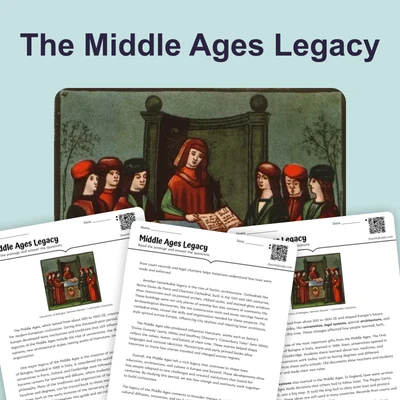
Middle Ages Legacy - reading educational content

Middle Ages Legacy

Reading Passage

$1.50
Passage
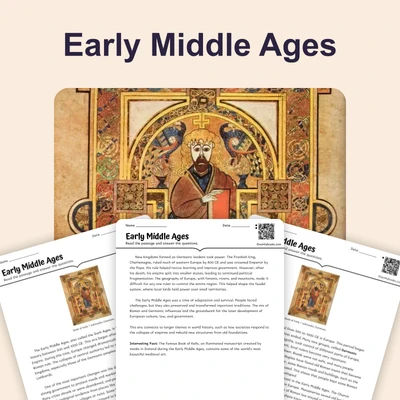
Early Middle Ages - reading educational content

Early Middle Ages

Reading Passage

$1.50
Passage
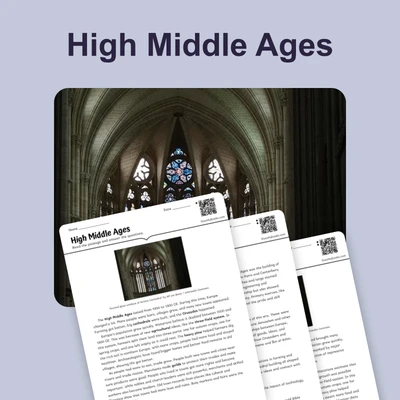
High Middle Ages - reading educational content

High Middle Ages

Reading Passage

$1.50
Passage
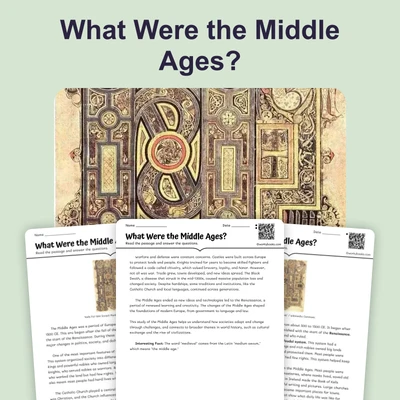
What Were the Middle Ages? - reading educational content

What Were the Middle Ages?

Reading Passage

$1.50
Passage
Late Middle Ages - reading educational content

Late Middle Ages

Reading Passage

$1.50
Passage
Dark Ages - reading educational content

Dark Ages

Reading Passage

$1.50
Passage
Life in Middle Ages - reading educational content

Life in Middle Ages

Reading Passage

$1.50
Passage
Medieval Islamic World - reading educational content

Medieval Islamic World

Reading Passage

$1.50
Passage
Women's Roles in the Middle Ages - reading educational content

Women's Roles in the Middle Ages

Reading Passage · HSS 7.6.1

$1.50
Passage
Islamic Golden Age - reading educational content

Islamic Golden Age

Reading Passage

$1.50
Passage
Medieval to Modern Transition - reading educational content

Medieval to Modern Transition

Reading Passage

$1.50
Passage
Medieval Words in English - reading educational content

Medieval Words in English

Reading Passage

$1.50
Passage
Age of Exploration Begins - reading educational content

Age of Exploration Begins

Reading Passage

$1.50
Passage
Italian City-States - reading educational content

Italian City-States

Reading Passage

$1.50
Passage
Attila the Hun - reading educational content

Attila the Hun

Reading Passage

$1.50
Passage
Medieval Guilds - reading educational content

Medieval Guilds

Reading Passage

$1.50
Passage
Medieval Christian Worship - reading educational content

Medieval Christian Worship

Reading Passage

$1.50
Passage
Power of the Pope - reading educational content

Power of the Pope

Reading Passage

$1.50
Passage
Carolingian Renaissance - reading educational content

Carolingian Renaissance

Reading Passage

$1.50
Passage
Islamic Golden Age Inventions - reading educational content

Islamic Golden Age Inventions

Reading Passage

$1.50
Copyright © 2026 Workybooks. Made with ♥ in California.