Spanish Reconquista
Interactive passage with audio narration, comprehension questions, and printable PDF.
By completing this purchase you agree to our Terms of Use and Privacy Policy. Your subscription renews automatically until you cancel. You can cancel anytime from your account settings. All sales are final and non-refundable. Digital content is available for download in your account immediately upon purchase.
What's included
Spanish Reconquista preview and details
About this printable Spanish Reconquista reading passage (Grades 5-8)
Sample passage and quiz from Spanish Reconquista
Reading passage and comprehension quiz preview
Spanish Reconquista
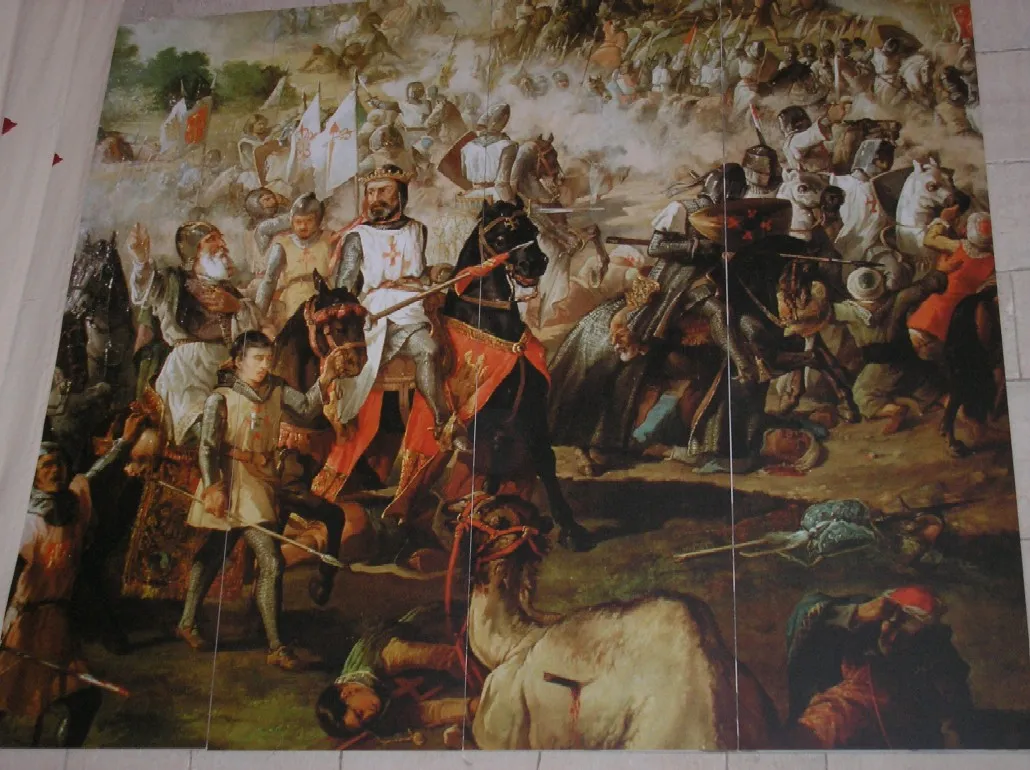
Scenes of the Reconquista by the Military Orders by Valdoria.Wikimedia Commons
The Reconquista was a period of about 700 years, from 711 to 1492, when Christian kingdoms in northern Spain fought to reclaim land from Muslim rulers. This long campaign shaped the history, culture, and geography of the Iberian Peninsula. The word Reconquista means “reconquest” in Spanish. It began after Muslim armies from North Africa, known as the Moors, conquered much of Spain in 711 CE, creating the powerful territory called Al-Andalus.
Christian resistance started almost immediately. In 722, a small Christian army led by Pelayo won a key victory at the Battle of Covadonga in the mountains of Asturias. This battle is considered by historians as the first step in the Reconquista. Over the next centuries, Christian kingdoms such as Castile, Aragon, and León slowly expanded southward. They built alliances and established strongholds in cities like Toledo, which was captured in 1085. The Christian kingdoms often united against the Muslims, but sometimes fought each other for power and territory.
Throughout the Reconquista, daily life changed for people of all religions and social classes. In some regions, Christians, Muslims, and Jews lived side by side, sharing knowledge in areas such as science, architecture, and agriculture. However, tensions and conflict were frequent. Historical records, like the chronicles of Alfonso X of Castile, describe both cooperation and periods of violence. Castles and fortified towns dotted the landscape, serving as centers of defense and administration for Christian lords. Social hierarchy was strict, with nobles and clergy holding power over peasants and townspeople.
The final stage of the Reconquista began in the late 1400s. The Christian monarchs Ferdinand of Aragon and Isabella of Castile married in 1469, uniting their powerful kingdoms. Together, they launched a campaign to seize Granada, the last Muslim stronghold. After a long siege, Granada surrendered in 1492. This marked the end of Muslim rule in Spain and the completion of the Reconquista. The monarchs issued decrees that impacted religious minorities, including the expulsion of Jews and Muslims who would not convert to Christianity.
The Reconquista transformed Spain by shaping its language, religion, and culture. It also influenced the start of Spain’s global exploration, as Ferdinand and Isabella sponsored Christopher Columbus in 1492. The Reconquista’s legacy can be seen in Spanish art, architecture, and traditions even today.
As you study the Reconquista, consider how geography, religion, and social structure influenced this long conflict, and how its outcomes connect to other major changes in world history.
Interesting Fact: Some historians believe that the library of Toledo, filled with Arabic, Latin, and Hebrew texts, helped preserve and spread ancient knowledge across Europe during the Middle Ages.
Comprehension quiz (8 questions)
1. When did the Reconquista end?
2. Who were the Moors?
3. What city did Christians capture in 1085?
4. What event marked the start of the Reconquista?
5. How did Ferdinand and Isabella unite Christian kingdoms?
6. What was a result of the Reconquista?
7. The Reconquista lasted about 700 years. True or false?
8. What does "hierarchy" mean?
Perfect for the way you teach
- Build comprehension skills
- Auto-graded quiz
- Differentiated reading
- Read together at home
- Improve fluency
- Quiet reading time
- Reading curriculum support
- Independent practice
- Track Lexile growth