Reading PassagePremium

Stationary Fronts

Interactive passage with audio narration, comprehension questions, and printable PDF.

No ratings yet
Grades 5–8ScienceElaEnglish · SpanishInteractive · Printable
Aligned toMS-ESS2-5
Just this resource
$1.50
One-time purchase
Best value
Unlock everything
$49.99$29.99/yr
40% off until Aug 1 — 10,000+ resources
Renews at $49.99/year.
Unlock above to use these actions

What's included

Reading passage
Audio narration
Comprehension quiz
Writing activity
Glossary & flashcards
Differentiated version
Spanish translation

Stationary Fronts preview and details

About this printable Stationary Fronts science reading passage, NGSS-aligned (Grades 5-8)

This comprehensive 400-500 word reading passage explains stationary fronts for middle school students in grades 6-8. Students learn how stationary fronts form when two air masses meet but neither advances, creating boundaries where weather can persist for days. The passage describes how these fronts produce prolonged precipitation in the same area and have caused severe flooding events, including the devastating 1993 Mississippi River floods. Students explore weather map symbols showing alternating blue triangles and red semicircles pointing in opposite directions. The content aligns with NGSS standards MS-ESS2.D and MS-ESS2-5, focusing on weather and climate patterns. Audio-integrated features support diverse learners, while differentiated versions and Spanish translations ensure accessibility. Activities include comprehension questions, writing prompts, and graphic organizers that help students analyze cause-and-effect relationships in atmospheric systems.
Written by Workybooks TeamPublished by Workybooks
Preview

Sample passage and quiz from Stationary Fronts

Reading passage and comprehension quiz preview

What Are Stationary Fronts
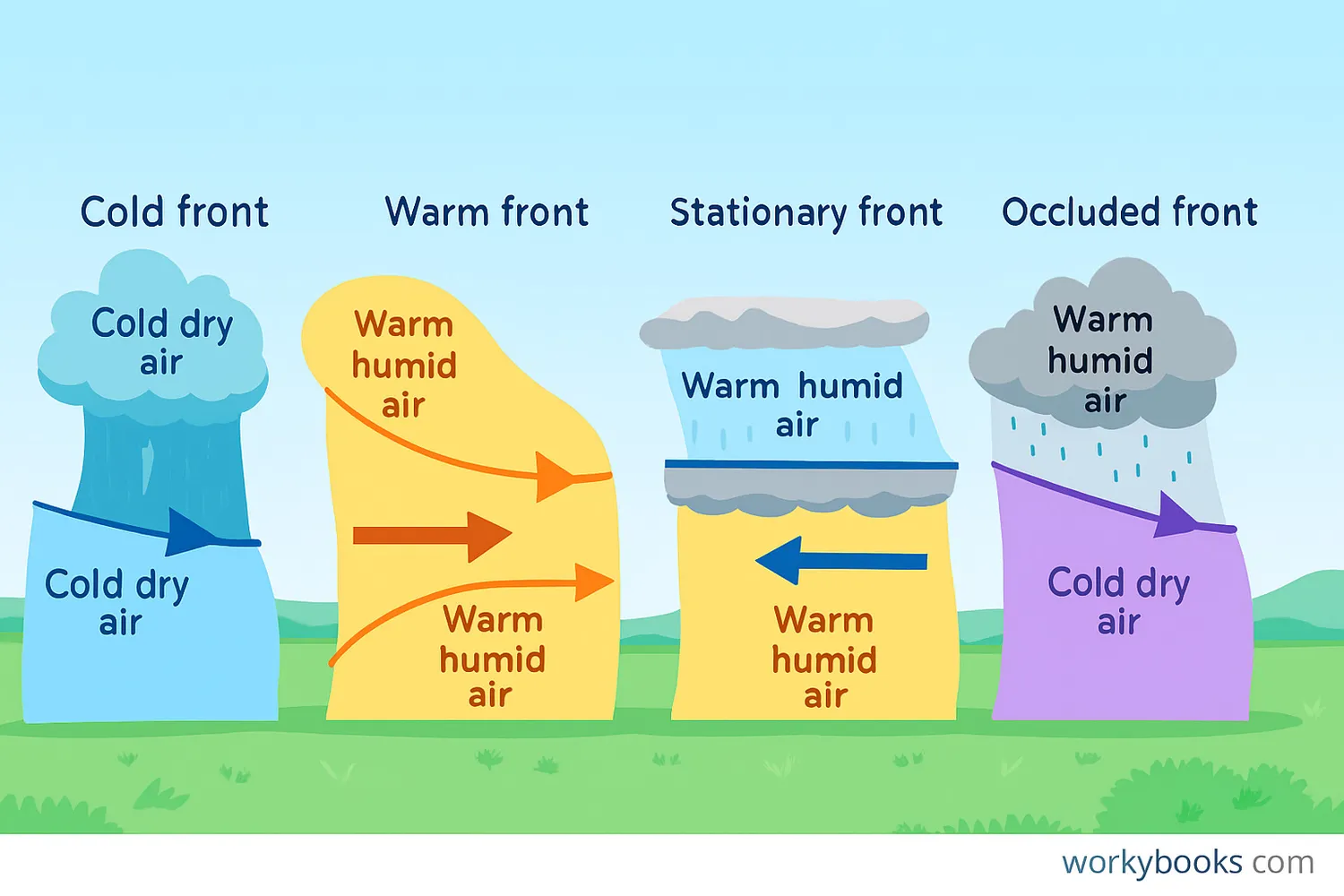
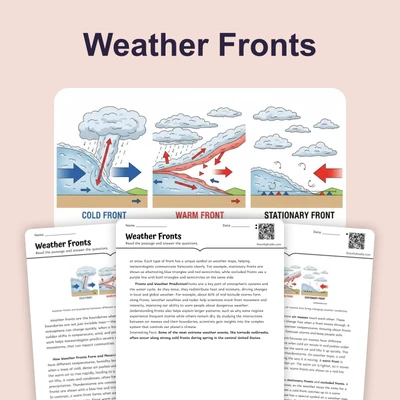
Wide diagram of cold, warm, stationary, and occluded fronts with air masses and weather effects. Caption: Air masses collide to form weather fronts, causing rain, storms, or cloudy skies.

A stationary front forms when two different air masses meet but neither one advances. The word "stationary" means not moving. These fronts create a boundary in the atmosphere where weather conditions remain stuck in place. Cold air and warm air push against each other with equal force. Neither air mass is strong enough to move the other out of the way.

When a stationary front develops, clouds and precipitation often form along the boundary. Warm air rises over the cooler air, creating conditions for rain or snow. This weather can last for several days because the front stays in the same location. The same region may receive rain day after day. Scientists observe that stationary fronts can produce some of the heaviest rainfall totals in the United States.

Meteorologists use special symbols to show stationary fronts on weather maps. The symbol includes alternating blue triangles and red semicircles pointing in opposite directions. The triangles point toward the warm air, while the semicircles point toward the cold air. This symbol helps forecasters communicate where the stalled boundary is located. Weather observers can then predict which areas may experience prolonged storms.

Stationary fronts can cause severe flooding when they remain over the same area for extended periods. Evidence shows that these weather systems played a major role in the devastating 1993 Mississippi River floods. Rain fell across the central United States for weeks. The Mississippi River and its tributaries could not handle the massive amount of water. Communities along the river experienced record-breaking flood levels. This event demonstrated how stationary fronts can lead to natural disasters.

Understanding stationary fronts helps scientists predict weather patterns and warn communities about potential flooding. These fronts are an important part of Earth's atmospheric system. They influence temperature, precipitation, and severe weather events. Studying how air masses interact allows meteorologists to improve forecasts and help people prepare for dangerous conditions.

Interesting Fact: A stationary front can remain in place for a week or longer, dumping more than 10 inches of rain on the same location during that time.

Comprehension quiz (10 questions)

1. What happens when a stationary front forms?

Two air masses meet but neither one advances
Warm air pushes cold air away quickly
Cold air moves rapidly across the country
Air masses combine into one large mass

2. What does the word 'stationary' mean in the context of weather fronts?

Moving quickly
Not moving
Spinning in circles
Changing direction

3. Why can stationary fronts produce prolonged precipitation in the same area?

Because they move very quickly across regions
Because they only last for a few hours
Because they remain in the same location for days
Because they prevent clouds from forming

4. What symbol is used on weather maps to show stationary fronts?

All blue triangles pointing one direction
Alternating blue triangles and red semicircles pointing in opposite directions
Red circles with arrows
Purple lines with no symbols

5. What real-world event demonstrated the danger of stationary fronts?

The 2005 Hurricane Katrina
The 1993 Mississippi River floods
The 2011 tornado outbreak
The 1980 Mount St. Helens eruption

6. What does 'precipitation' mean in the passage?

Wind speed
Air temperature
Water that falls from clouds as rain or snow
The movement of air masses

7. If a stationary front stays over a city for five days, what weather condition would the city most likely experience?

Five days of sunshine with no clouds
Rapidly changing weather each day
Several days of rain or storms
Extremely cold temperatures with no precipitation

8. How do meteorologists use information about stationary fronts to help communities?

They use it to create wind energy
They predict weather patterns and warn about potential flooding
They use it to control the weather
They ignore stationary fronts because they are not dangerous

9. True or False: In a stationary front, one air mass is always strong enough to push the other air mass away.

True
False

10. True or False: Stationary fronts can remain in place for a week or longer.

True
False
Who it's for

Perfect for the way you teach

Teachers
  • Build comprehension skills
  • Auto-graded quiz
  • Differentiated reading
Parents
  • Read together at home
  • Improve fluency
  • Quiet reading time
Homeschoolers
  • Reading curriculum support
  • Independent practice
  • Track Lexile growth
Topics

Reviews & Ratings

No reviews yet. Be the first to share your experience!

More reading you might love

20 more
Passage
Cold Fronts and Warm Fronts - reading educational content
Grades 5–8

Cold Fronts and Warm Fronts

weather and climate · MS-ESS2-5

$1.50
Passage
The Intertropical Convergence Zone (ITCZ): Earth's Weather Belt - reading educational content
Grades 5–8

The Intertropical Convergence Zone (ITCZ): Earth's Weather Belt

science · MS-ESS2-5

Free
Passage
What Is the Antarctic Polar Vortex - reading educational content
Grades 3–7

What Is the Antarctic Polar Vortex

weather and climate · MS-ESS2-5

Free
Passage
What Causes the Temperature to Decrease with Height in the Troposphere - reading educational content
Grades 3–7

What Causes the Temperature to Decrease with Height in the Troposphere

weather and climate · MS-ESS2-5

Free
Passage
Raining Frogs - reading educational content
Grades 5–8

Raining Frogs

life science · MS-ESS2-5

Free
Passage
How Adiabatic Cooling Makes Clouds - reading educational content
Grade 6

How Adiabatic Cooling Makes Clouds

weather and climate · MS-ESS2-5

$1.50
Passage
Hurricanes and Tropical Cyclones - reading educational content
Grades 5–8

Hurricanes and Tropical Cyclones

weather and climate · MS-ESS3-2

$1.50
Passage
Tornadoes - reading educational content
Grades 5–8

Tornadoes

weather and climate · MS-ESS3-2

$1.50
Passage
Weather Factors - reading educational content
Grades 5–8

Weather Factors

weather and climate · MS-ESS2-5

$1.50
Passage
Air Pressure - reading educational content
Grades 5–8

Air Pressure

science · MS-ESS2-5

$1.50
Passage
Wind - reading educational content
Grades 5–8

Wind

science · MS-ESS2-5

$1.50
Passage
Clouds and Precipitation - reading educational content
Grades 5–8

Clouds and Precipitation

weather and climate · MS-ESS2-5

$1.50
Passage
Air Masses - reading educational content
Grades 5–8

Air Masses

weather and climate · MS-ESS2-5

$1.50
Passage
Weather Maps and Forecasting - reading educational content
Grades 5–8

Weather Maps and Forecasting

weather and climate · MS-ESS2-5

$1.50
Passage
Weather Fronts - reading educational content
Grades 5–8

Weather Fronts

weather and climate · MS-ESS2-5

$1.50
Passage
What Is Meteorology - reading educational content
Grades 6–8

What Is Meteorology

earth and space science · MS-ESS2-5

$1.50
Passage
Do Trees Cause Wind - reading educational content
Grades 5–8

Do Trees Cause Wind

weather and climate · MS-ESS2-5

Free
Passage
Why San Francisco Is Foggy - reading educational content
Grades 5–8

Why San Francisco Is Foggy

weather and climate · MS-ESS2-5

$1.50
Passage
How Do Scientists Measure Weather - reading educational content
Grades 5–8

How Do Scientists Measure Weather

weather and climate · MS-ESS2-5

$1.50
Passage
How Do Weather Satellites Work - reading educational content
Grades 5–8

How Do Weather Satellites Work

weather and climate · MS-ESS2-5

$1.50
Copyright © 2026 Workybooks. Made with ♥ in California.