Travels of Marco Polo
Interactive passage with audio narration, comprehension questions, and printable PDF.
By completing this purchase you agree to our Terms of Use and Privacy Policy. Your subscription renews automatically until you cancel. You can cancel anytime from your account settings. All sales are final and non-refundable. Digital content is available for download in your account immediately upon purchase.
What's included
Travels of Marco Polo preview and details
About this printable Travels of Marco Polo reading passage (Grades 5-8)
Sample passage and quiz from Travels of Marco Polo
Reading passage and comprehension quiz preview
Travels of Marco Polo
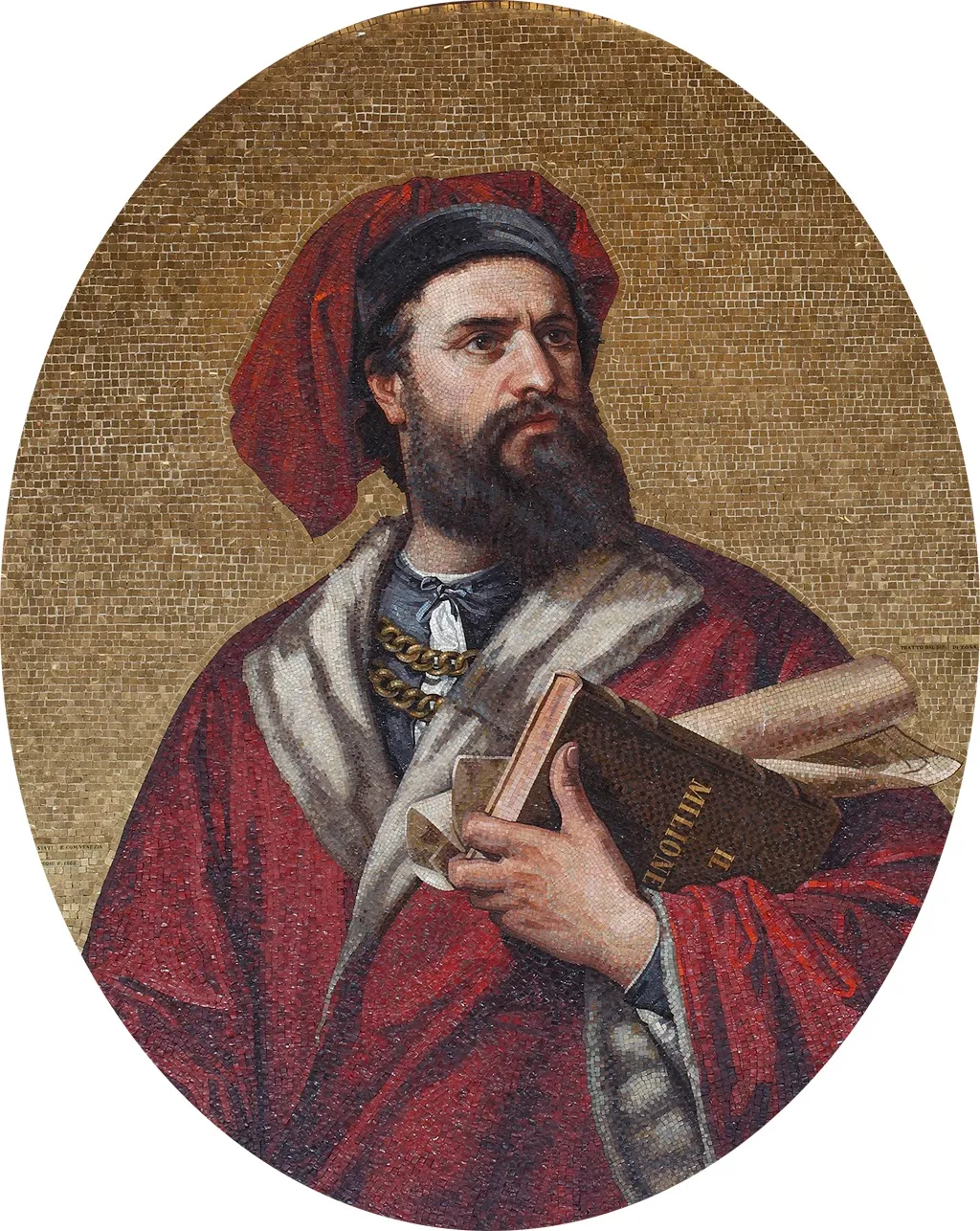
"Marco Polo Mosaic from Palazzo Tursi" by Salviati / Wikimedia Commons.
Marco Polo was a Venetian merchant whose 24-year journey to China in the 13th century became one of the most famous adventures of the Middle Ages. Born in Venice in 1254, Marco Polo set out with his father, Niccolò, and uncle, Maffeo, in 1271. Their goal was to reach the court of Kublai Khan, the powerful Mongol ruler of China. Marco Polo’s experiences and his detailed record of Asian lands greatly expanded European knowledge of the East.
The Polos traveled along the Silk Road, a vast network of trade routes connecting Europe and Asia. Their journey crossed dangerous deserts, high mountains, and unfamiliar kingdoms. They passed through cities such as Acre, Tabriz, and Kashgar. According to Marco’s book, they relied on local guides and merchants to find their way. The travelers finally arrived at Kublai Khan’s court in the city of Khanbaliq (modern-day Beijing) in 1275, after over three years on the road.
Kublai Khan welcomed the Polos and was especially impressed by Marco’s intelligence and curiosity. Marco learned several Asian languages and became a trusted envoy for the Khan. He was sent on missions to distant parts of the empire, observing everything from the postal system to the use of paper money. Marco’s detailed descriptions of Chinese inventions, such as coal for heating and printing with movable type, fascinated Europeans who had never seen these technologies. He also described the complex bureaucracy and hierarchy of the Mongol Empire, where officials managed trade, taxes, and law across vast territories.
After 17 years in China, the Polos left Khanbaliq in 1292, escorting a Mongol princess to Persia. They returned to Venice in 1295. Europe was skeptical of Marco’s stories. While in prison after a naval battle, he dictated his adventures to a writer named Rustichello da Pisa. The book, called The Travels of Marco Polo, became a sensation. Historians debate the accuracy of some details, but archaeological finds and Chinese sources confirm many of his observations. His account provided one of the earliest European views of Asia’s riches, cultures, and technologies.
Marco Polo’s journey changed how Europeans saw the world. His book inspired explorers like Christopher Columbus to seek new routes to Asia. It also encouraged trade and curiosity about distant lands. Though some medieval readers doubted his tales, Marco’s legacy endures as a symbol of cross-cultural exchange and the power of travel to open minds.
Interesting Fact: Marco Polo’s book was one of the first to describe China’s use of paper money, which was not yet common in Europe.
This story connects to the broader theme of how trade, travel, and cultural exchange shaped world history during the Middle Ages.
Comprehension quiz (8 questions)
1. Who was Kublai Khan?
2. How long did Marco Polo travel?
3. Which city did Marco Polo reach in 1275?
4. Why did Marco Polo become an envoy?
5. What effect did Marco Polo's book have?
6. What did Marco Polo describe in his book?
7. Marco Polo traveled the Silk Road. (True/False)
8. What is a 'bureaucracy'?
Perfect for the way you teach
- Build comprehension skills
- Auto-graded quiz
- Differentiated reading
- Read together at home
- Improve fluency
- Quiet reading time
- Reading curriculum support
- Independent practice
- Track Lexile growth