Viking Settlements
Interactive passage with audio narration, comprehension questions, and printable PDF.
By completing this purchase you agree to our Terms of Use and Privacy Policy. Your subscription renews automatically until you cancel. You can cancel anytime from your account settings. All sales are final and non-refundable. Digital content is available for download in your account immediately upon purchase.
What's included
Viking Settlements preview and details
About this printable Viking Settlements reading passage (Grades 5-8)
Sample passage and quiz from Viking Settlements
Reading passage and comprehension quiz preview
Vikings Become Settlers
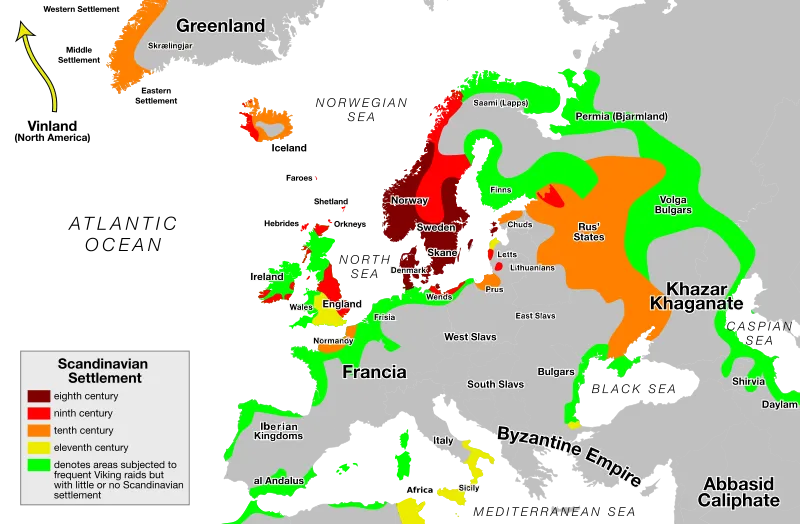
"Viking Expansion" by Max Naylor / Wikimedia Commons
The Vikings were a group of people from Scandinavia who became known across Europe for their travels and adventures. Starting around the late 8th century, Vikings sailed from present-day Norway, Sweden, and Denmark in longships. At first, they were famous for their raids on towns and monasteries along the coasts of England and France. However, after many years, the Vikings began to settle in the lands they once attacked, leading to important changes in European history.
One of the first major Viking settlements was in England. In 865 CE, the so-called “Great Heathen Army,” a large force of Vikings, invaded and conquered large parts of eastern England. Archaeological evidence from places like York (known as Jorvik to the Vikings) shows they built homes, traded with locals, and introduced their own laws and customs. Many Vikings married local people, and their descendants became part of English society. Over time, the Vikings in England began to adopt Christianity, especially after King Alfred the Great encouraged peace and the spread of Christian beliefs. Stone crosses and churches from this period show how Viking and English traditions blended together.
Vikings also settled in what is now northern France. In 911 CE, the Viking leader Rollo made a treaty with the French King Charles the Simple. Rollo and his followers were given land along the Seine River, which became known as Normandy, meaning “land of the Northmen.” The Vikings in Normandy quickly adopted the French language and became Christian. Within a few generations, they created a powerful society. In fact, the descendants of these settlers, known as Normans, would later conquer England in 1066 under William the Conqueror.
Farther east, Vikings known as the Rus traveled along rivers into present-day Russia and Ukraine. By setting up trading routes and towns like Novgorod and Kiev, they connected northern Europe to the Byzantine Empire. Archaeological finds, such as Norse-style jewelry and weapons in Russian burial sites, provide evidence of this contact. In the late 900s, the Rus ruler Vladimir the Great converted to Christianity, helping to spread the religion and connect his kingdom to European culture.
As the Vikings settled in new lands, they changed from warriors into farmers, traders, and rulers. Their integration into local societies led to a blending of customs, languages, and beliefs. The Vikings’ impact can still be seen today in place names, languages, and even government systems. Their story reveals how migration and cultural diffusion can shape societies over time. The transformation from raiders to settlers is a key example of how human actions drive change in world history.
This transition of Vikings from raiders to settlers connects to the broader theme of how migration, trade, and cultural exchange have influenced civilizations throughout the Middle Ages and beyond.
Interesting Fact: Some words in modern English, such as “sky” and “window,” come from Old Norse, the language of the Vikings.
Comprehension quiz (8 questions)
1. Where did the Vikings come from?
2. What is Normandy named after?
3. Who received Normandy from France?
4. Why did Vikings start to settle instead of raid?
5. How did Vikings blend with local societies?
6. What was a result of Viking settlement in Russia?
7. The Vikings never adopted Christianity. True or false?
8. What does "integration" mean?
Perfect for the way you teach
- Build comprehension skills
- Auto-graded quiz
- Differentiated reading
- Read together at home
- Improve fluency
- Quiet reading time
- Reading curriculum support
- Independent practice
- Track Lexile growth