Vikings and Kievan Rus
Interactive passage with audio narration, comprehension questions, and printable PDF.
By completing this purchase you agree to our Terms of Use and Privacy Policy. Your subscription renews automatically until you cancel. You can cancel anytime from your account settings. All sales are final and non-refundable. Digital content is available for download in your account immediately upon purchase.
What's included
Vikings and Kievan Rus preview and details
About this printable Vikings and Kievan Rus reading passage (Grades 5-8)
Sample passage and quiz from Vikings and Kievan Rus
Reading passage and comprehension quiz preview
Vikings and Kievan Rus
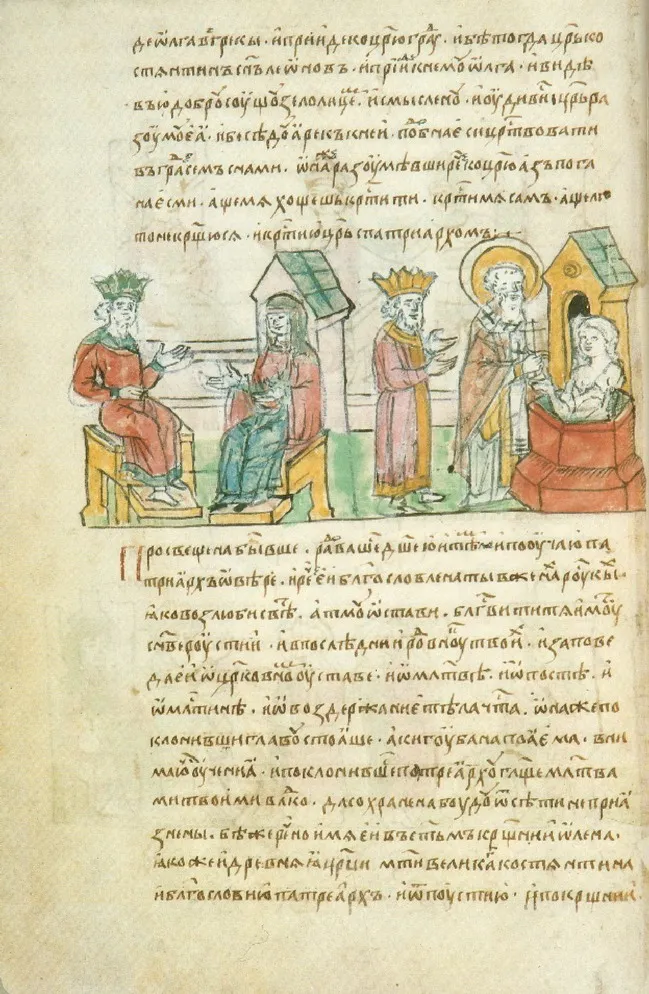
"Radzivill chronicle" / Wikimedia Commons.
The story of Russia’s origins begins with the Swedish Vikings, known as the Rus, who traveled and traded across the rivers of Eastern Europe beginning in the 9th century CE. These adventurous seafarers used their expertise in navigation and shipbuilding to journey from Scandinavia through what is now Russia, Ukraine, and Belarus. Their voyages were not only for trade but also for settlement, and they played a crucial role in founding the first major East Slavic state, known as Kievan Rus.
The Rus arrived in Eastern Europe around the year 860 CE, using rivers like the Dnieper and Volga as natural highways. Their longships could travel in shallow waters, allowing them to move swiftly between regions. According to the Primary Chronicle, a historical text written in Kiev in the 12th century, local Slavic and Finnic tribes invited the Rus leader, Rurik, to rule over them to bring order and peace. Archaeological finds, such as Scandinavian-style jewelry and weapons discovered in Novgorod, support the presence of Norse settlers in these early towns.
By the late 9th century, Rurik’s successor, Oleg, expanded the Rus’ control southward, capturing the city of Kiev in 882 CE. This event marked the beginning of the Kievan Rus state, which united various Slavic tribes under one rule. Kiev’s location on the Dnieper River made it an important center for trade between the Baltic Sea and the Byzantine Empire. The Rus traded furs, wax, and slaves for silver, silk, and other valuable goods. Written treaties from the 10th century, like the agreements between Prince Oleg and the Byzantine Emperor, show the Rus were recognized as powerful partners in international trade.
The society of Kievan Rus was diverse. Scandinavian warriors often became ruling elites, while local Slavic people made up most of the population. Over time, the Rus adopted many Slavic customs and the Eastern Orthodox religion, showing a blend of cultures. The use of rivers for trade and travel was essential for the state’s growth and stability. The legacy of Kievan Rus influenced later Russian, Ukrainian, and Belarusian cultures, even after the state’s decline in the 13th century.
The founding of Kievan Rus by the Swedish Vikings connects to broader themes in world history, such as migration, cultural exchange, and the rise of early states. It demonstrates how geography, like river systems, can shape human societies and foster connections between distant regions.
Interesting Fact: The word “Russia” comes from the name of the Rus, the Viking people who helped create the first Russian state.
Comprehension quiz (8 questions)
1. Who were the Rus?
2. Which river was important for Kiev?
3. Who captured Kiev in 882 CE?
4. Why did the Rus travel rivers?
5. How did geography help the Rus?
6. What is one legacy of Kievan Rus?
7. The Rus traded with the Byzantine Empire.
8. What does 'archaeological' mean?
Perfect for the way you teach
- Build comprehension skills
- Auto-graded quiz
- Differentiated reading
- Read together at home
- Improve fluency
- Quiet reading time
- Reading curriculum support
- Independent practice
- Track Lexile growth