What Are Stromatolites
Interactive passage with audio narration, comprehension questions, and printable PDF.
By completing this purchase you agree to our Terms of Use and Privacy Policy. Your subscription renews automatically until you cancel. You can cancel anytime from your account settings. All sales are final and non-refundable. Digital content is available for download in your account immediately upon purchase.
What's included
What Are Stromatolites preview and details
About this printable What Are Stromatolites science reading passage, NGSS-aligned (Grades 5-8)
Sample passage and quiz from What Are Stromatolites
Reading passage and comprehension quiz preview
What Are Stromatolites
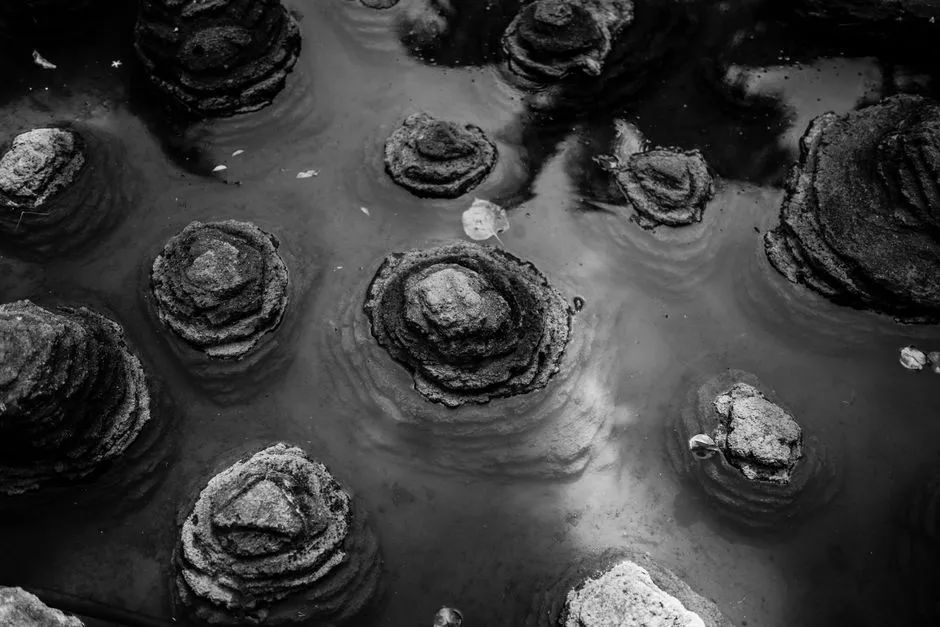
"Black and white image of stromatolites in water, showcasing natural textures and patterns." Image by Roktim | রক্তিম 🇧🇩 / Pexels.
Stromatolites are layered rock structures created by ancient bacterial mats. These remarkable formations represent some of Earth's oldest visible fossils. Scientists have found stromatolites that date back approximately 3.5 billion years. This means stromatolites formed when Earth was still very young. They provide crucial evidence about how life began on our planet.
Stromatolites form through a slow, gradual process involving cyanobacteria, which are microscopic organisms. These bacteria live in shallow water and form sticky mats on the ocean floor. Sediment particles stick to the bacterial mats over time. The bacteria then grow upward through the sediment, creating a new layer. This process repeats for thousands of years, building up distinct layers. Each layer represents a period of bacterial growth and sediment trapping. The layers harden into rock over millions of years through fossilization.
Living stromatolites still grow today in Shark Bay, Australia. This location has extremely salty water that most animals cannot survive in. The high salt content protects stromatolites from creatures that might eat the bacteria. Scientists study these modern stromatolites to understand ancient Earth conditions. Evidence shows that early stromatolites helped produce oxygen through photosynthesis. This oxygen gradually changed Earth's atmosphere from one with little oxygen to one that could support complex life.
Stromatolites matter because they connect us to Earth's distant past. They show how simple life forms can dramatically change a planet's environment. Scientists observe that stromatolites thrived for billions of years before more complex life evolved. Understanding stromatolites helps researchers learn about early Earth systems. These ancient structures also guide the search for life on other planets. If life exists elsewhere, it may leave similar layered structures behind.
Interesting Fact: Some stromatolites in Western Australia are still growing at a rate of only 0.4 millimeters per year, meaning it takes about 2,500 years to build just one meter of height.
Comprehension quiz (10 questions)
1. What are stromatolites?
2. How old are the oldest stromatolites that scientists have found?
3. What does the term 'cyanobacteria' refer to in the passage?
4. Based on the passage, what does 'fossilization' mean?
5. Why do living stromatolites still exist in Shark Bay, Australia?
6. How did ancient stromatolites help change Earth's atmosphere?
7. What can scientists learn by studying modern stromatolites in Shark Bay?
8. Why are stromatolites important for searching for life on other planets?
9. True or False: Stromatolites form quickly, taking only a few years to create visible layers.
10. True or False: Stromatolites provide evidence about how life began on Earth.
Perfect for the way you teach
- Build comprehension skills
- Auto-graded quiz
- Differentiated reading
- Read together at home
- Improve fluency
- Quiet reading time
- Reading curriculum support
- Independent practice
- Track Lexile growth