What Is a Geostationary Orbit
Interactive passage with audio narration, comprehension questions, and printable PDF.
By completing this purchase you agree to our Terms of Use and Privacy Policy. Your subscription renews automatically until you cancel. You can cancel anytime from your account settings. All sales are final and non-refundable. Digital content is available for download in your account immediately upon purchase.
What's included
What Is a Geostationary Orbit preview and details
About this printable What Is a Geostationary Orbit science reading passage, NGSS-aligned (Grades 5-8)
Sample passage and quiz from What Is a Geostationary Orbit
Reading passage and comprehension quiz preview
What Is a Geostationary Orbit?
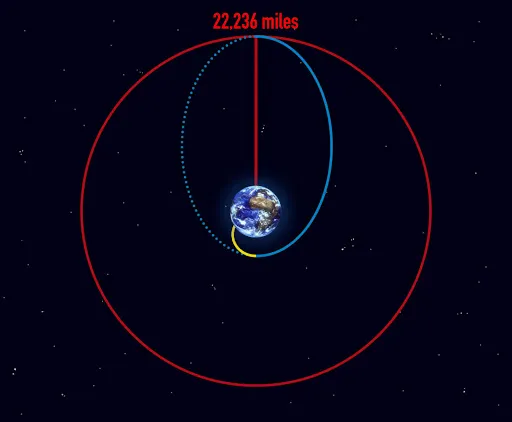
"NOAA’s GOES-T Reaches Geostationary Orbit, Now Designated GOES-18 (NESDIS 2022-03-14 goes-18-orbit-1)" by NOAA / Wikimedia Commons (Public domain).
A geostationary orbit is a special path around Earth where a satellite appears to stay in one place above the planet's surface. This happens when the satellite orbits at a precise altitude of approximately 36,000 kilometers above the equator. At this height, the satellite's orbital period matches Earth's rotation period of 24 hours. Scientists explain that this synchronous movement creates the illusion that the satellite hovers motionless over one spot.
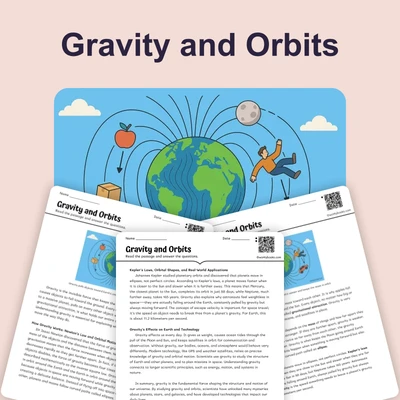
The physics behind geostationary orbits involves a balance between gravity and orbital speed. Earth's gravity pulls the satellite inward while the satellite's forward motion keeps it from falling. At 36,000 kilometers, these forces balance perfectly for a 24-hour orbit. Satellites closer to Earth orbit faster and complete their paths in less time. Satellites farther away orbit more slowly and take longer to circle the planet. Evidence shows that only satellites positioned at this specific altitude can remain over the same location.
Weather forecasting agencies use geostationary satellites to monitor storms and track climate patterns continuously. The National Oceanic and Atmospheric Administration operates GOES satellites in geostationary orbit. These satellites can observe the same region of Earth constantly, providing updated images every few minutes. Telecommunications companies also rely on geostationary satellites to transmit television signals and internet data. A single satellite in this orbit can cover about one-third of Earth's surface.
Geostationary orbits matter because they enable technologies that affect daily life. Weather predictions help communities prepare for dangerous storms and extreme conditions. Communication networks connect people across continents for business and personal interactions. Scientists continue to develop new uses for these orbits. Understanding orbital mechanics helps humans design better satellite systems for monitoring Earth and supporting global communications.
Interesting Fact: All geostationary satellites orbit directly above Earth's equator in a ring-shaped path called the Clarke Belt, named after science fiction writer Arthur C. Clarke who first described this concept in 1945.
Comprehension quiz (10 questions)
1. At what altitude above Earth's equator do geostationary satellites orbit?
2. How long does it take a geostationary satellite to complete one orbit around Earth?
3. What does the term 'synchronous' mean in the context of geostationary orbits?
4. Which organization operates GOES satellites mentioned in the passage?
5. Why do satellites at 36,000 kilometers altitude appear to hover over one spot on Earth?
6. What happens to satellites that orbit closer to Earth than 36,000 kilometers?
7. How much of Earth's surface can one geostationary satellite observe?
8. What two main applications of geostationary satellites are described in the passage?
9. True or False: All geostationary satellites orbit directly above Earth's equator.
10. True or False: Arthur C. Clarke first described the concept of geostationary orbit in 1995.
Perfect for the way you teach
- Build comprehension skills
- Auto-graded quiz
- Differentiated reading
- Read together at home
- Improve fluency
- Quiet reading time
- Reading curriculum support
- Independent practice
- Track Lexile growth