What Is a Satellite
Interactive passage with audio narration, comprehension questions, and printable PDF.
By completing this purchase you agree to our Terms of Use and Privacy Policy. Your subscription renews automatically until you cancel. You can cancel anytime from your account settings. All sales are final and non-refundable. Digital content is available for download in your account immediately upon purchase.
What's included
What Is a Satellite preview and details
About this printable What Is a Satellite science reading passage, NGSS-aligned (Grades 5-8)
Sample passage and quiz from What Is a Satellite
Reading passage and comprehension quiz preview
What Is a Satellite
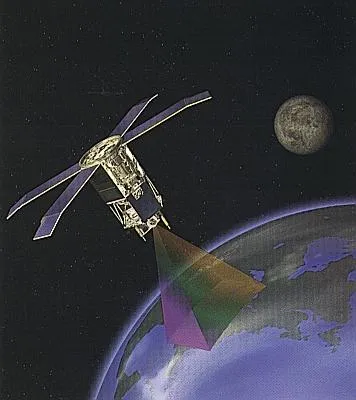
"SeaStar satellite orbit" by NASA / Wikimedia Commons
A satellite is any object that moves in a curved path, called an orbit, around a larger body in space. This definition includes two main types of satellites. Natural satellites form through natural processes in space. Artificial satellites are human-made objects that people launch into space for specific purposes.
The Moon is Earth's natural satellite. It orbits our planet because gravity pulls it toward Earth while its forward motion keeps it from falling. This balance creates a stable orbit. Scientists explain that any moon orbiting a planet is a natural satellite. Jupiter has 95 known natural satellites, while Mars has only two. Evidence shows that natural satellites can be very large, like our Moon, or quite small.
Artificial satellites serve many important functions in modern life. The International Space Station orbits Earth and provides a laboratory for scientific research. Communication satellites relay television signals, phone calls, and internet data across the globe. Weather satellites monitor storms and help meteorologists predict conditions. GPS satellites send signals that enable navigation systems to determine precise locations. Scientists observe that more than 8,000 artificial satellites currently orbit Earth.
Launching artificial satellites requires careful planning and powerful rockets. Engineers design satellites to withstand extreme temperatures and radiation in space. Solar panels provide electrical power for satellite systems. Ground stations on Earth communicate with satellites to control their operations and receive data. Each satellite serves its specific mission, whether taking photographs of Earth, studying distant stars, or connecting people across continents.
Understanding satellites matters because they help us study Earth's systems and improve daily life. Weather satellites can track hurricanes and save lives through early warnings. Environmental satellites monitor climate change, deforestation, and ocean health. Communication satellites connect remote areas to global networks. Scientists use satellites to measure sea levels, track wildlife, and study atmospheric conditions. This technology enables research that would be impossible from Earth's surface alone.
Interesting Fact: The first artificial satellite, Sputnik 1, launched by the Soviet Union in 1957, was only about the size of a beach ball and orbited Earth for three months before falling back into the atmosphere.
Comprehension quiz (10 questions)
1. What is a satellite?
2. Which of the following is an example of a natural satellite?
3. What does the term 'orbit' mean in the context of satellites?
4. According to the passage, what keeps the Moon from falling into Earth?
5. Which type of artificial satellite helps meteorologists predict weather conditions?
6. Based on the passage, why are satellites important for studying Earth?
7. What can be inferred about the relationship between the number of natural satellites and the size of a planet?
8. If a new artificial satellite were designed to help ships navigate the ocean, which existing satellite type would it most closely resemble?
9. True or False: All satellites are human-made objects.
10. True or False: Sputnik 1 was the first artificial satellite launched into space.
Perfect for the way you teach
- Build comprehension skills
- Auto-graded quiz
- Differentiated reading
- Read together at home
- Improve fluency
- Quiet reading time
- Reading curriculum support
- Independent practice
- Track Lexile growth