What Is Inertia
Interactive passage with audio narration, comprehension questions, and printable PDF.
By completing this purchase you agree to our Terms of Use and Privacy Policy. Your subscription renews automatically until you cancel. You can cancel anytime from your account settings. All sales are final and non-refundable. Digital content is available for download in your account immediately upon purchase.
What's included
What Is Inertia preview and details
About this printable What Is Inertia science reading passage, NGSS-aligned (Grades 5-8)
Sample passage and quiz from What Is Inertia
Reading passage and comprehension quiz preview
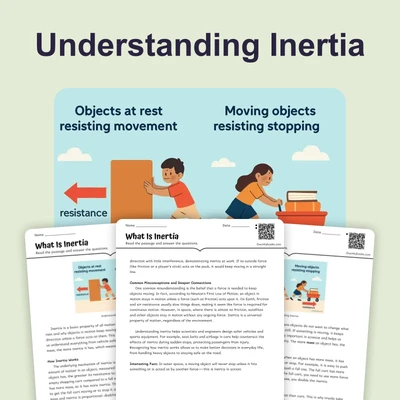
What Is Inertia
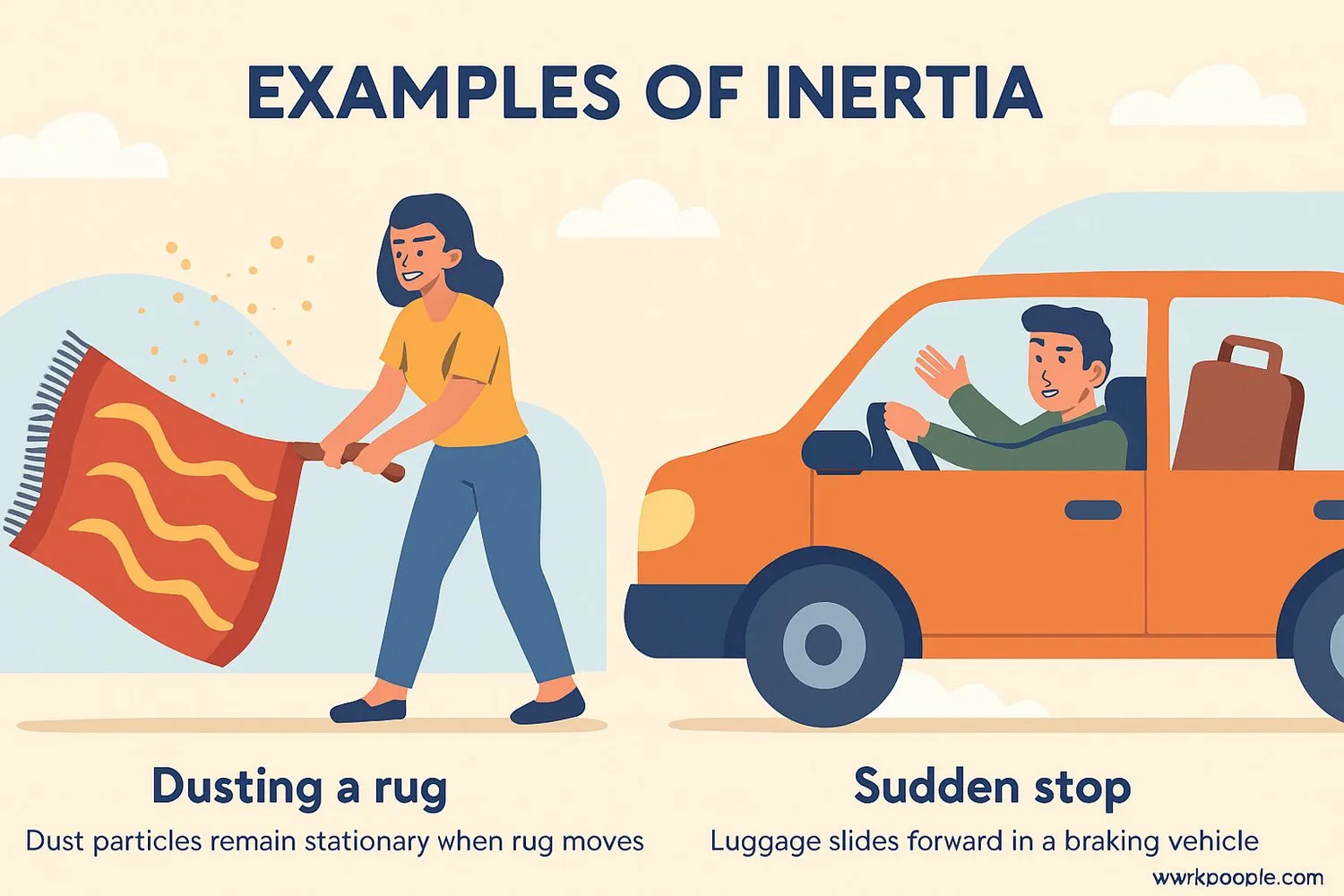
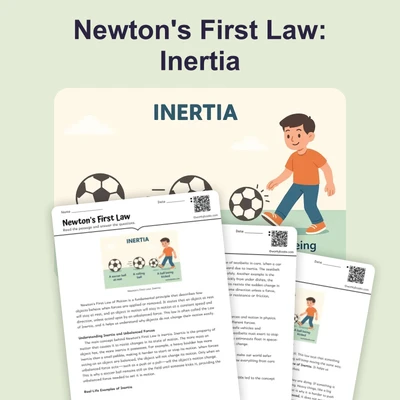
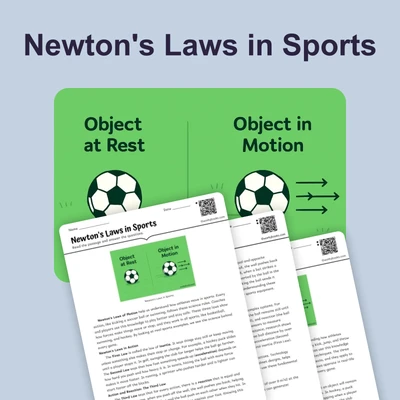
Inertia is an object's natural tendency to resist changes in motion. This means that objects at rest tend to stay at rest. Objects in motion tend to keep moving in a straight line at the same speed. Scientists explain that inertia is a fundamental property of all matter. Understanding inertia helps us predict how objects will behave when forces act on them.
The amount of inertia an object has depends on its mass. Mass measures how much matter is in an object. Objects with more mass have greater inertia. This means they resist changes in motion more strongly. A bowling ball has much more inertia than a tennis ball. The bowling ball is harder to start rolling and harder to stop once it moves. Scientists observe that this relationship between mass and inertia applies to all objects, from tiny atoms to massive planets.
Newton's First Law of Motion describes inertia in a precise way. The law states that an object will remain at rest or in uniform motion unless acted upon by an external force. Evidence shows that without forces like friction or gravity, a moving object would continue forever. In space, where friction is nearly absent, spacecraft can coast for years without using fuel. Their inertia keeps them moving in a straight line at constant velocity.
Seat belts demonstrate inertia in action during car travel. When a car stops suddenly, passengers continue moving forward because of their inertia. The seat belt applies a force that stops the passenger's motion safely. Without this force, the passenger would keep moving at the car's original speed. Engineers design safety features based on understanding how inertia affects human bodies during crashes. This knowledge has saved countless lives on roadways around the world.
Inertia matters because it affects everything we do. Athletes use inertia when they follow through on a swing or throw. Factory workers account for inertia when moving heavy machinery. Space agencies calculate inertia when planning spacecraft trajectories. Scientists explain that inertia, along with gravity, forms the foundation for understanding how forces create motion. These two concepts work together to explain the movement of objects from baseballs to galaxies.
Interesting Fact: A hockey puck sliding on ice can travel over 60 meters before friction finally stops it. This demonstrates how objects with low friction can maintain motion for surprisingly long distances due to inertia.
Comprehension quiz (10 questions)
1. What is inertia?
2. What determines how much inertia an object has?
3. In the context of the passage, what does 'velocity' mean?
4. What does 'mass' measure in an object?
5. Why can spacecraft coast for years in space without using fuel?
6. How do seat belts use the concept of inertia to keep passengers safe?
7. According to Newton's First Law, what happens to an object in motion if no force acts on it?
8. Which object would have more inertia: a bowling ball or a tennis ball?
9. True or False: Objects at rest tend to stay at rest because of inertia.
10. True or False: Inertia only affects objects that are moving, not objects that are at rest.
Perfect for the way you teach
- Build comprehension skills
- Auto-graded quiz
- Differentiated reading
- Read together at home
- Improve fluency
- Quiet reading time
- Reading curriculum support
- Independent practice
- Track Lexile growth