What Is the Stratosphere
Interactive passage with audio narration, comprehension questions, and printable PDF.
What's included
What Is the Stratosphere preview and details
About this printable What Is the Stratosphere science reading passage, NGSS-aligned (Grades 5-8)
Sample passage and quiz from What Is the Stratosphere
Reading passage and comprehension quiz preview
What Is the Stratosphere
The stratosphere is the second layer of Earth's atmosphere, extending from about 12 kilometers to 50 kilometers above the surface. This layer sits directly above the troposphere, where weather occurs and where we live. The stratosphere has unique characteristics that make it very different from the layer below it.
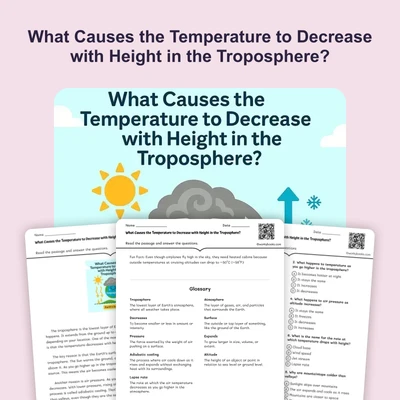
One of the most unusual features of the stratosphere is its temperature inversion. In the troposphere, temperature decreases as you go higher. However, in the stratosphere, the opposite happens. Temperature actually increases with altitude. Scientists explain this pattern by examining what happens in the ozone layer. The ozone layer exists within the stratosphere, between about 15 and 35 kilometers above Earth's surface. Ozone molecules absorb ultraviolet radiation from the sun. This absorption process releases heat energy, which warms the surrounding gas. The higher you go in the stratosphere, the more UV radiation the ozone absorbs, and the warmer it becomes.
The stratosphere is remarkably stable compared to the troposphere. Very few clouds form in this layer because there is little water vapor. Air moves in smooth, horizontal layers rather than mixing vertically. This stability creates ideal conditions for aircraft flight. Commercial jets often fly in the lower stratosphere to avoid turbulence. High-altitude weather balloons also travel through the stratosphere to collect atmospheric data. In the 1960s and 1970s, supersonic aircraft like the Concorde flew in the lower stratosphere, taking advantage of the smooth conditions and thinner air.
The ozone layer plays a critical role in protecting life on Earth. Evidence shows that ozone blocks most of the sun's harmful ultraviolet radiation from reaching the surface. Without this protection, UV radiation can damage living cells, cause skin cancer, and harm ecosystems. The stratosphere's stable structure helps keep the ozone layer in place. Scientists continue to monitor the stratosphere because human activities can affect ozone concentrations. Understanding this atmospheric layer helps us protect both the ozone layer and life on Earth.
Interesting Fact: The stratosphere is so stable that volcanic ash and dust particles can remain suspended there for months or even years, sometimes circling the entire planet and affecting global temperatures.
Comprehension quiz (10 questions)
1. What is the altitude range of the stratosphere?
2. How does temperature change in the stratosphere as altitude increases?
3. What does the term 'temperature inversion' mean in the context of the stratosphere?
4. What causes the temperature to increase in the stratosphere?
5. Why is the stratosphere described as 'stable'?
6. Based on the passage, why do commercial jets often fly in the lower stratosphere?
7. How does the ozone layer protect life on Earth?
8. If the ozone layer did not exist, what would likely happen to life on Earth?
9. The stratosphere contains very few clouds because it has little water vapor.
10. In the troposphere, temperature increases with altitude just like in the stratosphere.
Perfect for the way you teach
- Build comprehension skills
- Auto-graded quiz
- Differentiated reading
- Read together at home
- Improve fluency
- Quiet reading time
- Reading curriculum support
- Independent practice
- Track Lexile growth