What Was the Geocentric Model
Interactive passage with audio narration, comprehension questions, and printable PDF.
By completing this purchase you agree to our Terms of Use and Privacy Policy. Your subscription renews automatically until you cancel. You can cancel anytime from your account settings. All sales are final and non-refundable. Digital content is available for download in your account immediately upon purchase.
What's included
What Was the Geocentric Model preview and details
About this printable What Was the Geocentric Model science reading passage, NGSS-aligned (Grades 5-8)
Sample passage and quiz from What Was the Geocentric Model
Reading passage and comprehension quiz preview
What Was the Geocentric Model
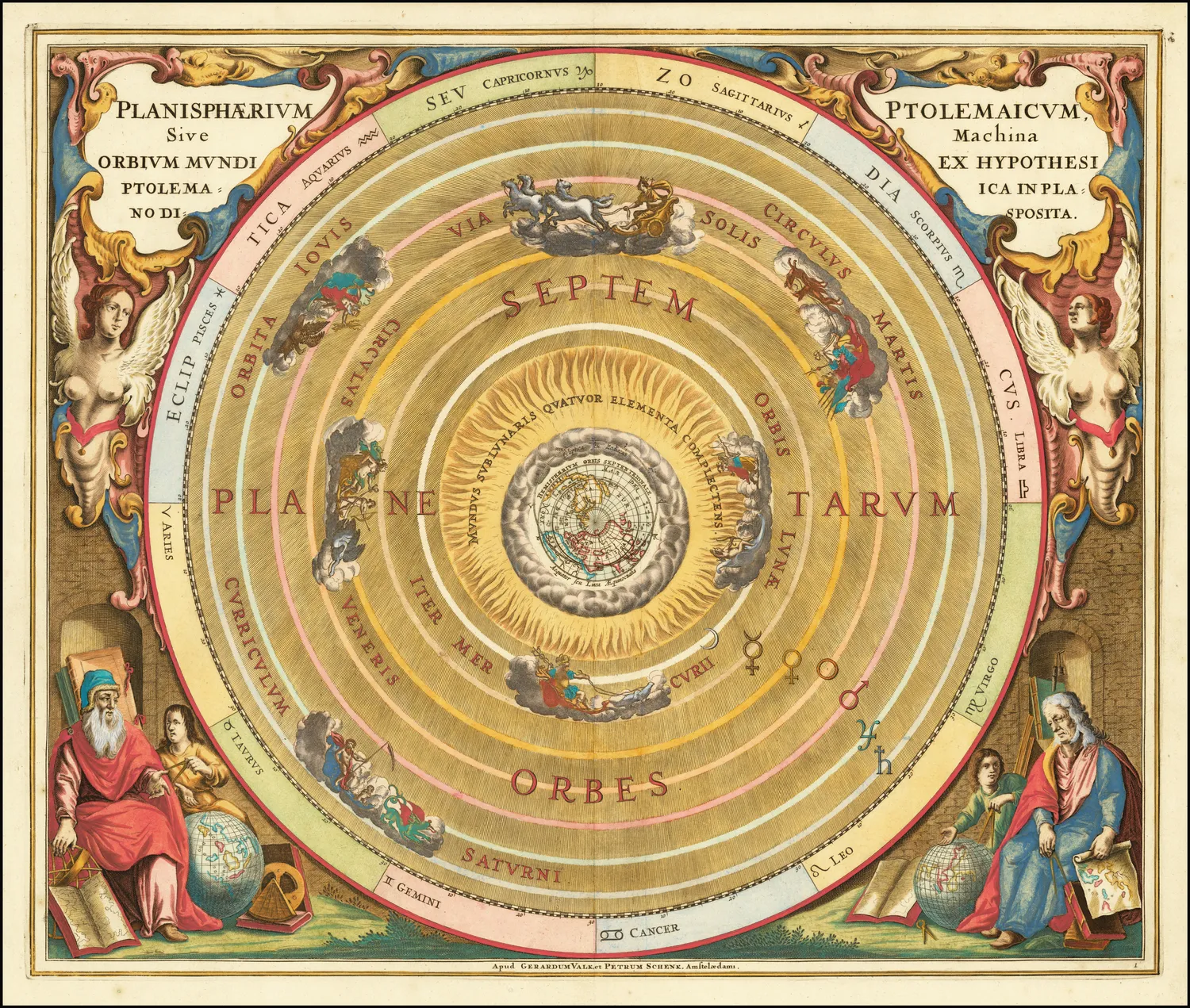
"1660 illustration of Claudius Ptolemy's geocentric model of the Universe" by Andreas Cellarius / Wikimedia Commons
The geocentric model was an ancient idea that placed Earth at the center of the universe. According to this model, the Sun, Moon, planets, and stars all moved in circular paths around our planet. For more than 1,400 years, most people believed this Earth-centered view explained what they saw in the sky.
Ancient observers noticed that the Sun rose in the east and set in the west each day. The Moon and stars also appeared to move across the sky. These observations seemed to show that everything in space circled around Earth. Greek astronomer Ptolemy refined this model around 150 CE. He created detailed mathematical rules to predict where planets would appear in the night sky. Ptolemy's system used epicycles, which were small circles within larger circular paths. These epicycles helped explain why planets sometimes appeared to move backward in the sky.
The geocentric model worked well for predicting some celestial events. Sailors used it to navigate across oceans. Farmers relied on it to track seasons. The model fit with common sense because people could not feel Earth moving beneath their feet. Religious and philosophical beliefs also supported the idea that Earth held a special, central position in the universe. Scientists continued to use Ptolemy's geocentric model throughout the Middle Ages and into the Renaissance.
Evidence eventually showed that the geocentric model was incorrect. In the 1500s, astronomer Nicolaus Copernicus proposed the heliocentric model, which placed the Sun at the center. Later observations with telescopes revealed that planets orbit the Sun, not Earth. Scientists explain that the apparent motion of the Sun and stars across our sky happens because Earth rotates on its axis. The geocentric model demonstrates how scientific understanding can change when new evidence emerges.
Interesting Fact: Ptolemy's geocentric model was so mathematically complex that it required over 80 circles to explain the motions of just seven known celestial bodies at that time.
Comprehension quiz (10 questions)
1. According to the geocentric model, what was located at the center of the universe?
2. Who refined the geocentric model around 150 CE?
3. What are epicycles in Ptolemy's model?
4. Why did the geocentric model seem to make sense to ancient people?
5. What does the word 'celestial' mean in the context of this passage?
6. Which model eventually replaced the geocentric model?
7. Based on the passage, why did planets sometimes appear to move backward in the sky according to Ptolemy's model?
8. What does the geocentric model demonstrate about scientific understanding?
9. The geocentric model dominated Western thought for over 1,400 years.
10. Ptolemy's geocentric model required only 10 circles to explain the motions of celestial bodies.
Perfect for the way you teach
- Build comprehension skills
- Auto-graded quiz
- Differentiated reading
- Read together at home
- Improve fluency
- Quiet reading time
- Reading curriculum support
- Independent practice
- Track Lexile growth