What Was the Heliocentric Model
Interactive passage with audio narration, comprehension questions, and printable PDF.
By completing this purchase you agree to our Terms of Use and Privacy Policy. Your subscription renews automatically until you cancel. You can cancel anytime from your account settings. All sales are final and non-refundable. Digital content is available for download in your account immediately upon purchase.
What's included
What Was the Heliocentric Model preview and details
About this printable What Was the Heliocentric Model science reading passage, NGSS-aligned (Grades 5-8)
Sample passage and quiz from What Was the Heliocentric Model
Reading passage and comprehension quiz preview
What Was the Heliocentric Model
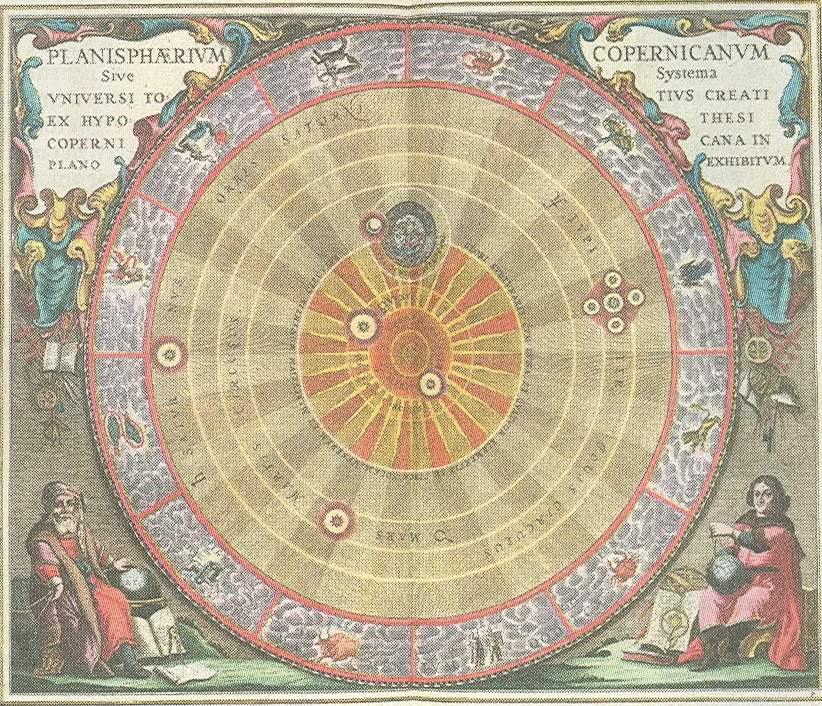
"Copernic solar system, Cellarius (1646)" by Andreas Cellarius / Wikimedia Commons
The heliocentric model is the idea that the Sun sits at the center of the solar system. Planets, including Earth, orbit around the Sun in this model. Polish astronomer Nicolaus Copernicus published this view in 1543. His work changed how people understood the universe.
Before Copernicus, most people accepted the geocentric model. This older view placed Earth at the center of everything. People believed the Sun, Moon, planets, and stars all moved around Earth. This idea matched what people saw each day. The Sun appeared to rise in the east and set in the west. However, this model created problems when explaining planetary motion. Planets sometimes seemed to move backward in the sky. Scientists had to create complicated explanations to account for these observations.
Copernicus proposed a simpler explanation. He suggested that Earth and other planets orbit the Sun. In this model, Earth also rotates on its axis. This rotation explains why the Sun appears to move across the sky. The heliocentric model made planetary motion easier to understand. Planets appear to move backward because Earth passes them in its orbit. Evidence from observations supported this new model.
The heliocentric model contradicted religious teachings of the time. Church leaders taught that Earth held a special place at the center of creation. Copernicus knew his ideas would face opposition. He delayed publishing his book until near the end of his life. Later astronomers like Galileo Galilei provided more evidence for the heliocentric model. Galileo observed moons orbiting Jupiter in 1610. This discovery showed that not everything orbited Earth.
The heliocentric model matters because it represents a major shift in scientific thinking. Scientists learned to base explanations on observations rather than beliefs. This approach became the foundation of modern science. The model also helped scientists understand that Earth is one planet among many. Our solar system follows predictable patterns based on gravity and motion.
Interesting Fact: Copernicus was not the first person to suggest a heliocentric model. Ancient Greek astronomer Aristarchus proposed a similar idea around 270 BCE, but his work was largely forgotten.
Comprehension quiz (10 questions)
1. What is the heliocentric model?
2. Who published the heliocentric model in 1543?
3. In the passage, the word 'orbit' means:
4. What does 'geocentric' mean in the context of this passage?
5. Why did the geocentric model have problems explaining planetary motion?
6. What evidence did Galileo provide to support the heliocentric model?
7. Why did Copernicus delay publishing his book?
8. How does the heliocentric model explain why the Sun appears to move across the sky?
9. True or False: The heliocentric model was immediately accepted by everyone when Copernicus published it.
10. True or False: Copernicus was the very first person in history to suggest a heliocentric model.
Perfect for the way you teach
- Build comprehension skills
- Auto-graded quiz
- Differentiated reading
- Read together at home
- Improve fluency
- Quiet reading time
- Reading curriculum support
- Independent practice
- Track Lexile growth