What Was the Oxygen Revolution
Interactive passage with audio narration, comprehension questions, and printable PDF.
By completing this purchase you agree to our Terms of Use and Privacy Policy. Your subscription renews automatically until you cancel. You can cancel anytime from your account settings. All sales are final and non-refundable. Digital content is available for download in your account immediately upon purchase.
What's included
What Was the Oxygen Revolution preview and details
About this printable What Was the Oxygen Revolution science reading passage, NGSS-aligned (Grades 5-8)
Sample passage and quiz from What Was the Oxygen Revolution
Reading passage and comprehension quiz preview
What Was the Oxygen Revolution
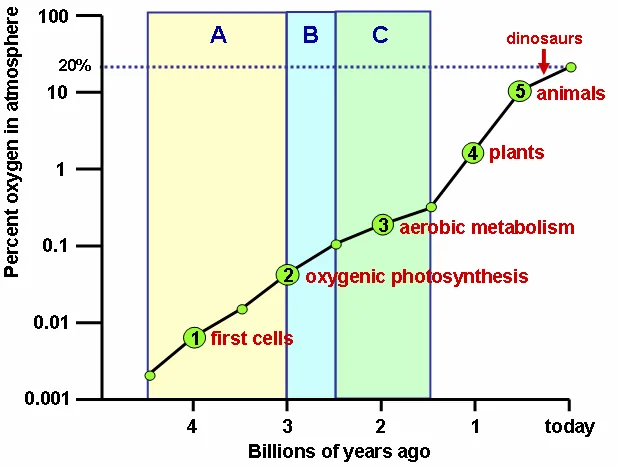
Representation of evolutionary and geological events leading to changes of oxygen content in earth's atmosphere since the formation of the planet by Tameeria at English Wikipedia / Wikimedia Commons
The Oxygen Revolution was a dramatic change in Earth's atmosphere that happened about 2.4 billion years ago. Scientists call this event the Great Oxidation Event. Tiny organisms called cyanobacteria began producing oxygen through photosynthesis. These microscopic bacteria used sunlight, water, and carbon dioxide to make food. Oxygen was released as a waste product. This process changed Earth's atmosphere forever.
Before cyanobacteria appeared, Earth's atmosphere contained almost no oxygen. Most organisms were anaerobic, meaning they lived without oxygen. When oxygen levels began to rise, this gas acted like poison to these early life forms. Evidence shows that the new oxygen caused one of the largest mass extinctions in Earth's history. Many species could not survive in the oxygen-rich environment. Scientists explain that this extinction cleared the way for new types of organisms to evolve.
The oxygen also reacted with iron dissolved in Earth's oceans. This chemical reaction created rust, which sank to the ocean floor. Over millions of years, these rust layers formed massive deposits called banded iron formations. Today, these formations provide important evidence of the Oxygen Revolution. The banded iron formations in Minnesota and Michigan contain billions of tons of iron ore. Geologists study these rocks to understand how Earth's atmosphere changed over time.
The Oxygen Revolution transformed Earth's atmosphere from one with almost no oxygen to one with significant oxygen levels. This change took hundreds of millions of years to complete. The new oxygen-rich atmosphere made it possible for complex life to evolve. Organisms could use oxygen for cellular respiration, a process that releases much more energy than anaerobic processes. Scientists observe that without the Oxygen Revolution, complex animals like fish, birds, and mammals could not exist. The ozone layer also formed from oxygen molecules. This protective layer shields Earth from harmful ultraviolet radiation.
The Oxygen Revolution matters because it shows how life can change an entire planet. Cyanobacteria were so successful that they altered Earth's chemistry and climate. This event reminds us that living organisms play a major role in shaping Earth's systems. Understanding this ancient event helps scientists predict how life and Earth's atmosphere may continue to change in the future.
Interesting Fact: The iron ore mined from banded iron formations created during the Oxygen Revolution is used to make steel for buildings, cars, and bridges today.
Comprehension quiz (10 questions)
1. When did the Oxygen Revolution occur?
2. What organisms were responsible for producing oxygen during the Oxygen Revolution?
3. What does the term 'anaerobic' mean in the context of the passage?
4. What were banded iron formations created from?
5. Why was the Oxygen Revolution important for complex life?
6. According to the passage, what can scientists learn by studying banded iron formations?
7. What effect did rising oxygen levels have on early anaerobic organisms?
8. What protective layer formed as a result of oxygen in the atmosphere?
9. True or False: Before cyanobacteria appeared, Earth's atmosphere contained high levels of oxygen.
10. True or False: The Oxygen Revolution shows that living organisms can change an entire planet.
Perfect for the way you teach
- Build comprehension skills
- Auto-graded quiz
- Differentiated reading
- Read together at home
- Improve fluency
- Quiet reading time
- Reading curriculum support
- Independent practice
- Track Lexile growth