Who Were the 'Barbarians'? — Reading Comprehension
Rate this
Premium Resource
Present
Present in classroom. No work saved
Assign
Classroom with student accounts, Track progress
Quick Play
No student accounts, assign with a link
Grades
5
6
7
8
PRINT+DIGITAL RESOURCE
This learning resource is available in interactive and printable formats. The interactive worksheet can be played online and assigned to students. The Printable PDF version can be downloaded and printed for completion by hand.
This engaging world history passage explores the question: Who were the 'Barbarians'? Students will examine how the Romans defined 'barbarian', focusing on major Germanic tribes such as the Goths, Vandals, and Franks. The passage addresses change over time, cause-and-effect relationships, and the impact of these groups on the decline of the Western Roman Empire. Students will analyze primary sources, archaeological findings, and multiple perspectives, and connect the movements of these tribes to broader geographic and social contexts. The reading passage is supported by a glossary, a Spanish translation, differentiated text, multiple-choice and writing activities, and graphic organizers to build both content and literacy skills. This resource is aligned with CA HSS 6.7.1, 6.7.2 and CCSS RI.6.3, and includes read aloud audio for accessibility.
CONTENT PREVIEW
Expand content preview
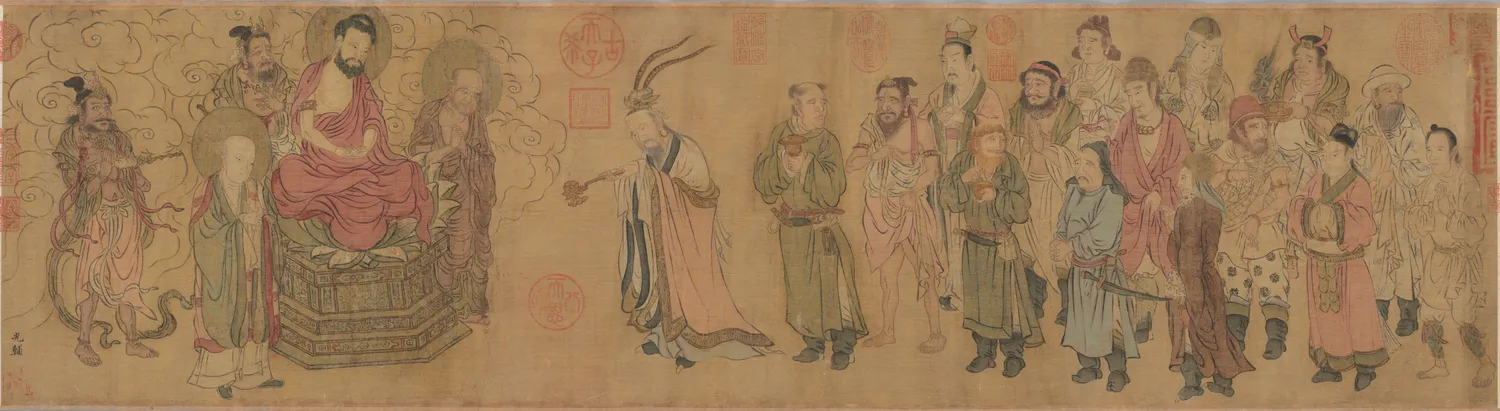
"Barbarian Royalty Worshiping the Buddha 蠻王禮佛圖 900s (Picture)" by Zhao Guangfu 趙光輔 (Chinese, c. 923–976) / Wikimedia Commons.
The Romans used the word barbarian to describe people who lived outside the Roman Empire, especially those who spoke different languages and had unfamiliar customs. This term did not refer to a single group, but to many diverse peoples. In Roman eyes, 'barbarians' were outsiders, but many of these groups had complex societies and rich traditions of their own.
During the late Roman Empire, from around the 3rd to the 5th centuries CE, several major Germanic tribes became especially important. Among these were the Goths, Vandals, and Franks. Each tribe had its own leaders, beliefs, and way of life. For example, the Goths were divided into two main branches: the Visigoths and Ostrogoths. Archaeological evidence, such as the Gothic silver found at Pietroasa in modern Romania, shows that these peoples valued craftsmanship and trade.
Contact between Rome and the Germanic tribes was often tense and sometimes violent. The Romans built frontier walls, like Hadrian’s Wall in Britain, to protect their borders. However, these barriers did not always stop migrations. In 376 CE, the Visigoths crossed the Danube River seeking refuge from the Huns. The Roman historian Ammianus Marcellinus described how thousands of Goths entered Roman territory, hoping for safety. Soon after, in 410 CE, the Visigoths led by Alaric famously sacked the city of Rome—a shocking event for the ancient world. The Vandals, another Germanic tribe, crossed into North Africa and captured Carthage in 439 CE, demonstrating their military power. Meanwhile, the Franks gradually settled in Roman Gaul (modern France) and eventually established a stable kingdom under leaders like Clovis around 500 CE.
These migrations and invasions were caused by several factors. Some tribes were pushed westward by the movement of the Huns from Central Asia. Others sought better land or were attracted by the wealth of the Roman Empire. Over time, many Germanic peoples adopted aspects of Roman culture, such as Christianity and Latin language, yet they also kept their own traditions. This blending of cultures shaped the future of Europe and marked the transition from ancient to medieval times.
Understanding the Roman idea of 'barbarian' helps us see how societies define themselves and others. The Germanic tribes were not simply destroyers—they were builders of new states and cultures. Their legacy can be traced in the languages, laws, and customs of modern Europe.
This topic connects to broader themes of migration, cultural exchange, and the rise and fall of civilizations, which are central to world history.
Interesting Fact: Some modern words, like 'vandalism', come from the names of these tribes, showing their lasting impact on our language.
Who did Romans call 'barbarians'?
People outside the empireRoman citizensGreek philosophersSenators
Which tribe sacked Rome in 410 CE?
GothsFranksVandalsRomans
Who established a kingdom in Gaul?
FranksVandalsGothsHuns
Why did some tribes move west?
Escaping the HunsSearching for goldAvoiding taxesBecoming Roman citizens
What did archaeological finds show about Goths?
They made silver objectsThey lived in EgyptThey spoke LatinThey built pyramids
What effect did the migrations have?
Blended culturesDestroyed all citiesStopped tradeCreated new empires
Barbarians always destroyed everything. True or false?
TrueFalse
What is a 'kingdom'?
Land ruled by a kingA Roman cityA type of weaponA group of traders
Perfect For:
👩🏫 Teachers
• Reading comprehension practice
• Auto-graded assessments
• Literacy skill development
👨👩👧👦 Parents
• Reading practice at home
• Comprehension improvement
• Educational reading time
🏠 Homeschoolers
• Reading curriculum support
• Independent reading practice
• Progress monitoring
Reading Features:
📖
Reading Passage
Engaging fiction or nonfiction text
❓
Comprehension Quiz
Auto-graded questions
📊
Instant Feedback
Immediate results and scoring
📄
Printable Version
Download for offline reading
🔊
Read Aloud
Voice-over with word highlighting
Reviews & Ratings
No reviews yet. Be the first to share your experience!
Related Content
Middle Ages Legacy
This history reading passage examines the lasting legacy of the Middle Ages, including the development of universities, ...
Early Middle Ages
This comprehensive reading passage explores the Early Middle Ages (500-1000 CE), a transformative period in European his...
High Middle Ages
This detailed world history reading passage explores the High Middle Ages (1000-1300 CE), a transformative era in Europe...
What Were the Middle Ages?
This engaging world history reading passage introduces students to the Middle Ages, the period in European history betwe...
Late Middle Ages
This rigorous world history reading passage explores the Late Middle Ages (1300-1500 CE), a time marked by the devastati...
Dark Ages
This passage offers a rigorous, engaging examination of why the early Middle Ages are often called the 'Dark Ages.' Stud...
Life in Middle Ages
This rigorous history reading passage explores life in Europe during the Middle Ages, focusing on the structure of feuda...
Medieval Islamic World
This rigorous reading passage delves into the Medieval Islamic World's golden age, when a vast civilization stretched fr...
Islamic Golden Age
This history reading passage explores the Islamic Golden Age, a period from the 8th to 14th centuries marked by outstand...
Medieval to Modern Transition
This engaging world history reading passage explores the dramatic transformation from the Middle Ages to the modern era,...
Medieval Words in English
This engaging history reading passage examines the evolution of the English language during the Middle Ages, focusing on...
Age of Exploration Begins
This engaging history reading passage explores the Age of Exploration, a turning point in world history when European po...
Italian City-States
This passage explores the rise and significance of the Italian city-states—Venice, Florence, and Genoa—during the Middle...
Attila the Hun
This engaging world history reading passage examines Attila the Hun, a powerful and feared ruler during the Middle Ages....
Medieval Guilds
This engaging world history reading passage explores the important role of guilds—worker groups that shaped the economy ...
Medieval Christian Worship
This detailed passage examines how people worshiped during the Middle Ages, focusing on essential religious practices su...
Power of the Pope
This history reading passage examines the power of the pope during the Middle Ages, focusing on his role as spiritual le...
Carolingian Renaissance
This engaging world history passage explores how Charlemagne, ruler of the Franks, transformed education and learning in...
Islamic Golden Age Inventions
This world history reading passage explores the remarkable inventions and scientific advances made in the medieval Islam...
Medieval Agricultural Innovations
This history reading passage explores how farming inventions like the heavy plow, three-field system, and horse collar r...