Why Oceans Drive the Water Cycle
Interactive passage with audio narration, comprehension questions, and printable PDF.
By completing this purchase you agree to our Terms of Use and Privacy Policy. Your subscription renews automatically until you cancel. You can cancel anytime from your account settings. All sales are final and non-refundable. Digital content is available for download in your account immediately upon purchase.
What's included
Why Oceans Drive the Water Cycle preview and details
About this printable Why Oceans Drive the Water Cycle science reading passage, NGSS-aligned (Grades 5-8)
Sample passage and quiz from Why Oceans Drive the Water Cycle
Reading passage and comprehension quiz preview
Why Oceans Drive the Water Cycle

The process of evaporation from oceans depends on two main factors working together: solar energy and ocean surface temperature. Image by Anton Klyuchnikov / Pexels.
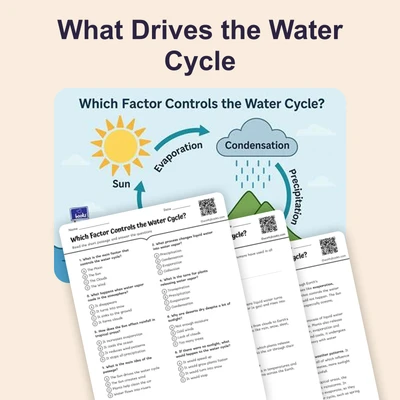
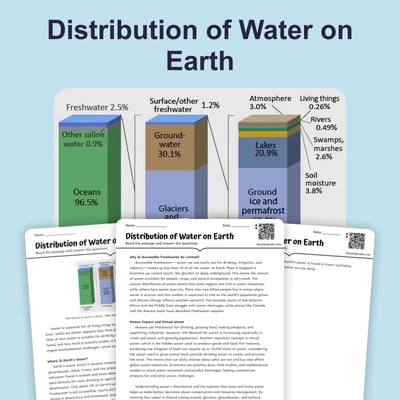
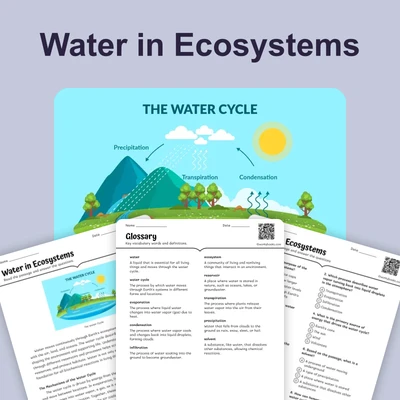
Oceans drive the water cycle because they cover most of Earth's surface and provide most of the water that evaporates into the atmosphere. Evidence shows that oceans cover 71% of our planet. This vast area means oceans supply 86% of all evaporation on Earth. When the sun heats ocean water, molecules gain energy and escape into the air as water vapor. This process begins the water cycle that shapes weather and climate worldwide.
Scientists explain that oceans also receive 78% of all precipitation that falls on Earth. Water that evaporates from oceans forms clouds over both sea and land. These clouds eventually release water as rain or snow. Some precipitation falls back into the oceans, while some falls on land and flows back to the sea through rivers. This continuous movement creates a cycle that distributes fresh water across the planet.
Tropical oceans near the equator evaporate the most water because they are the warmest. Warm water molecules move faster and escape into the air more easily than cold water molecules. The Indian Ocean and western Pacific Ocean can evaporate over 150 centimeters of water each year. This intense evaporation feeds powerful weather systems and carries moisture to distant regions.
Climate change is warming oceans and intensifying the water cycle in measurable ways. Warmer ocean temperatures increase evaporation rates, putting more water vapor into the atmosphere. Scientists observe that this extra moisture can fuel stronger hurricanes and produce heavier rainfall events. In 2017, Hurricane Harvey dropped over 150 centimeters of rain on parts of Texas. The unusually warm Gulf of Mexico waters provided extra energy and moisture for this storm.
Understanding why oceans drive the water cycle matters for predicting future weather patterns and preparing for climate impacts. Oceans act as Earth's largest reservoir of water and heat. As oceans continue to warm, scientists expect the water cycle to become more intense. This may mean longer droughts in some regions and more extreme flooding in others. Studying ocean-atmosphere interactions helps scientists develop better climate models and improve weather forecasts that protect communities worldwide.
Interesting Fact: A single water molecule that evaporates from the ocean spends an average of only 10 days in the atmosphere before falling back to Earth as precipitation.
Comprehension quiz (10 questions)
1. What percentage of Earth's surface do oceans cover?
2. How much of Earth's total evaporation comes from oceans?
3. What does the term 'water vapor' mean in the passage?
4. According to the passage, what does 'precipitation' refer to?
5. Why do tropical oceans evaporate more water than other ocean regions?
6. Based on the passage, what can be inferred about the relationship between ocean temperature and evaporation?
7. How is climate change affecting the water cycle according to the passage?
8. If oceans continue to warm, what might happen to weather patterns in the future?
9. True or False: Oceans receive 78% of all precipitation that falls on Earth.
10. True or False: Hurricane Harvey was weakened by cold Gulf of Mexico waters.
Perfect for the way you teach
- Build comprehension skills
- Auto-graded quiz
- Differentiated reading
- Read together at home
- Improve fluency
- Quiet reading time
- Reading curriculum support
- Independent practice
- Track Lexile growth