Why We Only See One Side of the Moon
Interactive passage with audio narration, comprehension questions, and printable PDF.
By completing this purchase you agree to our Terms of Use and Privacy Policy. Your subscription renews automatically until you cancel. You can cancel anytime from your account settings. All sales are final and non-refundable. Digital content is available for download in your account immediately upon purchase.
What's included
Why We Only See One Side of the Moon preview and details
About this printable Why We Only See One Side of the Moon science reading passage, NGSS-aligned (Grades 5-8)
Sample passage and quiz from Why We Only See One Side of the Moon
Reading passage and comprehension quiz preview
Why We See One Side of the Moon
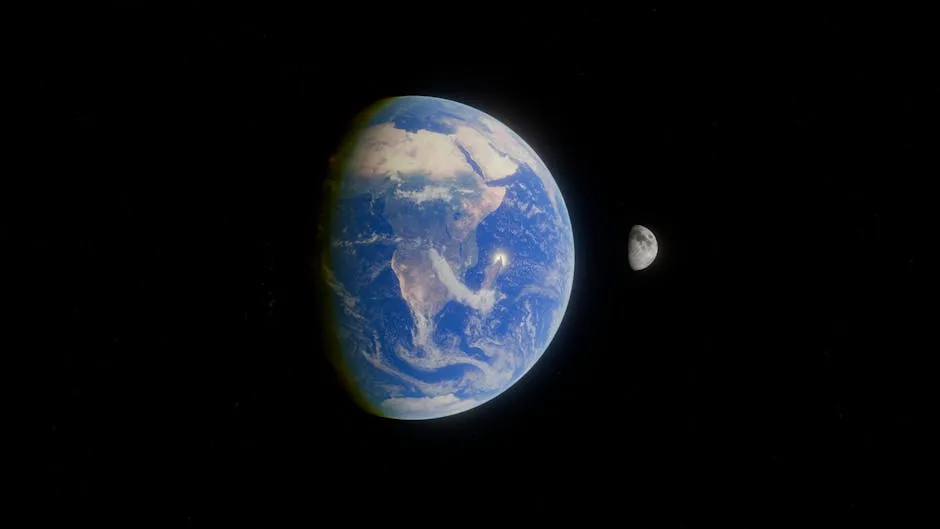
"A captivating view of Earth and its moon floating in the vast expanse of space." by Zelch Csaba / Pexels.
Why do we see only one side of the Moon from Earth? The answer lies in a process called tidal locking. Earth's gravity locked the Moon's rotation to match its orbit. This means the Moon does spin, but it rotates exactly once during each trip around Earth.
Scientists explain that tidal locking happens over millions of years. Earth's gravitational pull creates forces on the Moon. These forces act more strongly on the side of the Moon closest to Earth. Over time, this uneven pull slowed the Moon's rotation. Eventually, the Moon's spin became synchronized with its orbit around Earth. Evidence shows this process took about 100 million years to complete.
The Moon takes about 27.3 days to orbit Earth once. It also takes 27.3 days to spin once on its axis. Because these two motions match perfectly, the same lunar face points toward Earth constantly. Scientists call this synchronous rotation. The side we see is called the near side. The hidden side is called the far side of the Moon.
For thousands of years, humans could only observe the Moon's near side. This changed in 1959 when the Soviet space probe Luna 3 flew behind the Moon. The probe captured the first photographs of the far side. These images revealed a surface very different from the near side. The far side has more craters and fewer dark areas called maria.
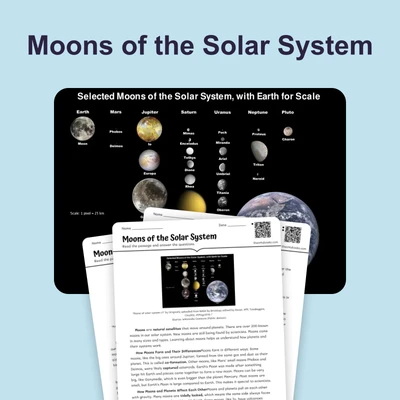
Understanding tidal locking helps scientists study other moons in our solar system. Many moons orbiting Jupiter and Saturn also show synchronous rotation. This phenomenon demonstrates how gravitational forces shape the motion of objects in space. Tidal locking connects Earth and Moon in a cosmic dance that began billions of years ago.
Interesting Fact: The Moon is slowly moving away from Earth at a rate of about 3.8 centimeters per year. As it drifts farther away, Earth's days are gradually getting longer!
Comprehension quiz (10 questions)
1. What is tidal locking?
2. How long does it take the Moon to complete one orbit around Earth?
3. What does the term 'synchronous rotation' mean?
4. According to the passage, approximately how long did tidal locking take to complete?
5. What historic event happened in 1959?
6. Why does Earth's gravity affect the Moon more strongly on one side?
7. What did Luna 3's photographs reveal about the Moon's far side?
8. How does understanding tidal locking help scientists?
9. True or False: The Moon does not spin at all.
10. True or False: Many moons orbiting Jupiter and Saturn also show synchronous rotation.
Perfect for the way you teach
- Build comprehension skills
- Auto-graded quiz
- Differentiated reading
- Read together at home
- Improve fluency
- Quiet reading time
- Reading curriculum support
- Independent practice
- Track Lexile growth