Earth's Magnetic Field
Interactive passage with audio narration, comprehension questions, and printable PDF.
By completing this purchase you agree to our Terms of Use and Privacy Policy. Your subscription renews automatically until you cancel. You can cancel anytime from your account settings. All sales are final and non-refundable. Digital content is available for download in your account immediately upon purchase.
What's included
Earth's Magnetic Field preview and details
About this printable Earth's Magnetic Field science reading passage, NGSS-aligned (Grades 5-8)
Sample passage and quiz from Earth's Magnetic Field
Reading passage and comprehension quiz preview
Earth's Magnetic Field
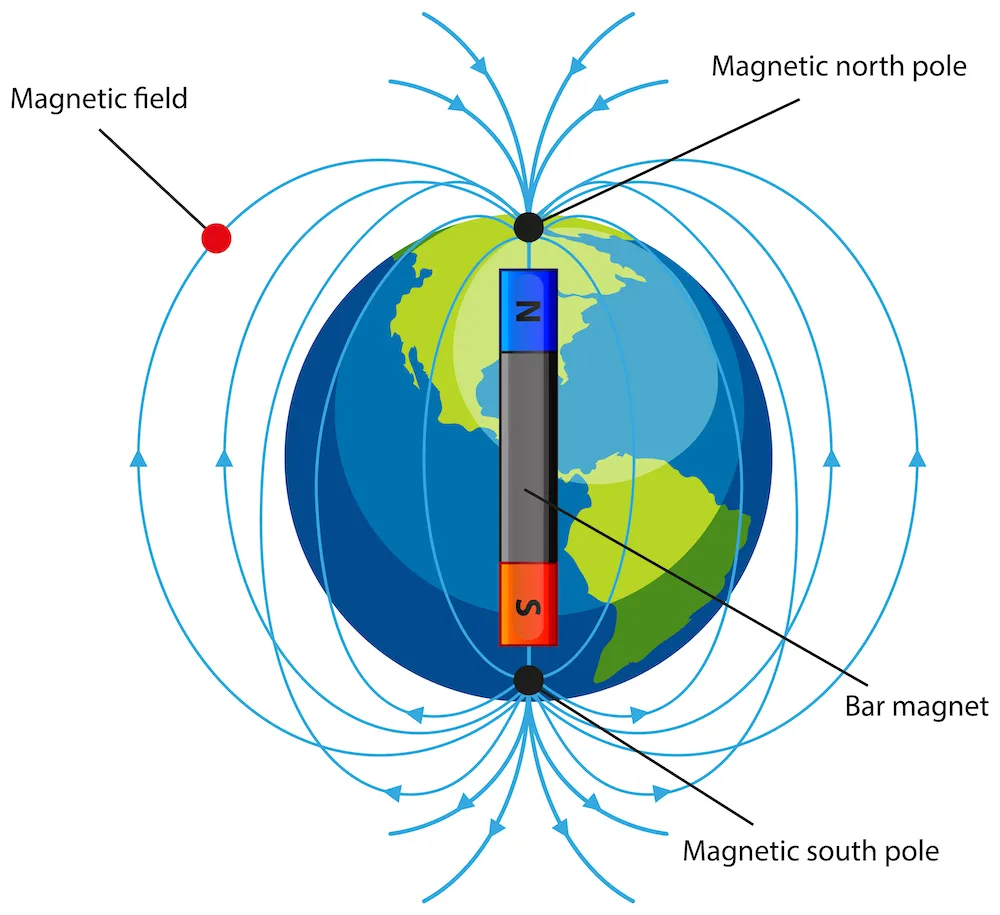
Earth's magnetic field is a powerful force that surrounds our planet and influences many natural processes. This invisible shield extends from the Earth's interior out into space and plays a crucial role in protecting life. One key feature of the magnetic field is that Earth acts as a giant magnet, with a north magnetic pole and a south magnetic pole. However, these magnetic poles are not located at the same places as the geographic poles, which are the true north and south points on Earth's surface. Understanding how the magnetic field is created and why it matters is essential for appreciating Earth's dynamic systems.
How Earth Generates Its Magnetic Field
Earth's core consists of a solid inner core and a liquid outer core made mostly of iron and nickel. The movement of molten iron in the outer core produces electric currents. According to the dynamo theory, these currents generate Earth's magnetic field. The field lines form loops, stretching from one magnetic pole to the other, and extend far into space. Scientists have measured that the strength of Earth's magnetic field at the surface is about 25 to 65 microteslas, which is strong enough to protect the atmosphere. Evidence for this comes from observations of how compasses align with the field and from satellite measurements. The difference in location between geographic and magnetic poles means that a compass points to magnetic north, not true north.
Protection and Phenomena: Effects of the Magnetic Field
One of the most important roles of Earth's magnetic field is to shield the planet from solar wind and cosmic radiation. Solar wind is a stream of charged particles released from the Sun, traveling at speeds up to 800 kilometers per second. Without the magnetic field, these particles could strip away the ozone layer and damage living cells. The magnetic field deflects most of the harmful radiation, concentrating some particles near the poles. When these charged particles interact with gases in Earth's atmosphere, they create spectacular lights called auroras, also known as the northern and southern lights. Scientists have also found that the magnetic field helps migratory animals, like sea turtles and birds, navigate long distances by detecting the field's direction and strength.
Wandering Poles and Magnetic Reversals
Earth's magnetic poles are not fixed; they wander over time due to changes in the flow of molten iron in the core. In the past century, the north magnetic pole has moved from northern Canada toward Siberia at a rate of about 55 kilometers per year. Over geological time scales, the magnetic poles have even reversed, with north and south swapping places. These magnetic reversals occur irregularly, about every 200,000 to 300,000 years, though the last reversal happened about 780,000 years ago. Scientists study patterns in volcanic rocks and sediments to understand when and how reversals occurred. These changes do not happen suddenly, but over thousands of years, allowing ecosystems to adapt.
Earth's magnetic field is a dynamic, essential system that influences navigation, protects life, and reveals the active processes deep within our planet. Its study connects physical science, Earth science, and the broader principles of energy and matter in systems. As technology advances, understanding the magnetic field will help us better protect satellites and electronic systems from solar storms.
Interesting Fact:
During a magnetic reversal, the strength of Earth's magnetic field drops, but the planet still remains protected from most solar and cosmic radiation.
Comprehension quiz (10 questions)
1. What is one main function of Earth's magnetic field?
2. Which part of Earth is mainly responsible for generating its magnetic field?
3. What are auroras and how are they formed?
4. What does the 'dynamo theory' explain?
5. The magnetic poles and geographic poles are located in the same place. (True/False)
6. How often do magnetic reversals occur on average?
7. What evidence do scientists use to study past magnetic reversals?
8. Which animal uses Earth's magnetic field to help with long-distance navigation?
9. Solar wind consists of charged particles released from the Sun that can harm living things if not for Earth's magnetic field. (True/False)
10. Why is the difference between the magnetic and geographic poles important for navigation?
Perfect for the way you teach
- Build comprehension skills
- Auto-graded quiz
- Differentiated reading
- Read together at home
- Improve fluency
- Quiet reading time
- Reading curriculum support
- Independent practice
- Track Lexile growth