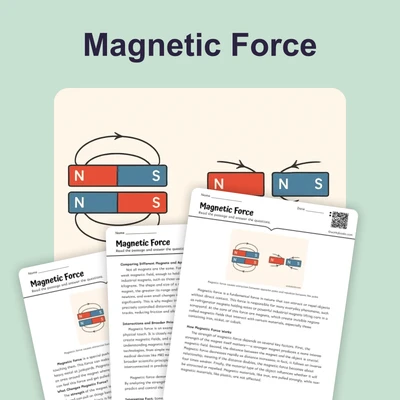
This learning resource is available in interactive and printable formats. The interactive worksheet can be played online and assigned to students. The Printable PDF version can be downloaded and printed for completion by hand.
This comprehensive middle school science passage explores the concept of magnetic fields, defined as the region around a magnet where magnetic forces act. Aligned with NGSS standards MS-PS2-3 and MS-PS2-5, the reading explains how scientists visualize magnetic fields using iron filings and field lines, describes the rules for drawing magnetic field lines, and discusses why the field is strongest at a magnet’s poles. The passage also compares magnetic fields to gravitational and electric fields, helping students understand how these invisible forces act at a distance. Real-world examples and applications, such as the role of Earth’s magnetic field in navigation, are included. The package features a glossary, differentiated reading options, Spanish translations, a multiple-choice quiz, writing prompts, and graphic organizers for effective learning. This resource is audio-integrated for accessibility, supporting a wide range of learners.
CONTENT PREVIEW
Expand content preview
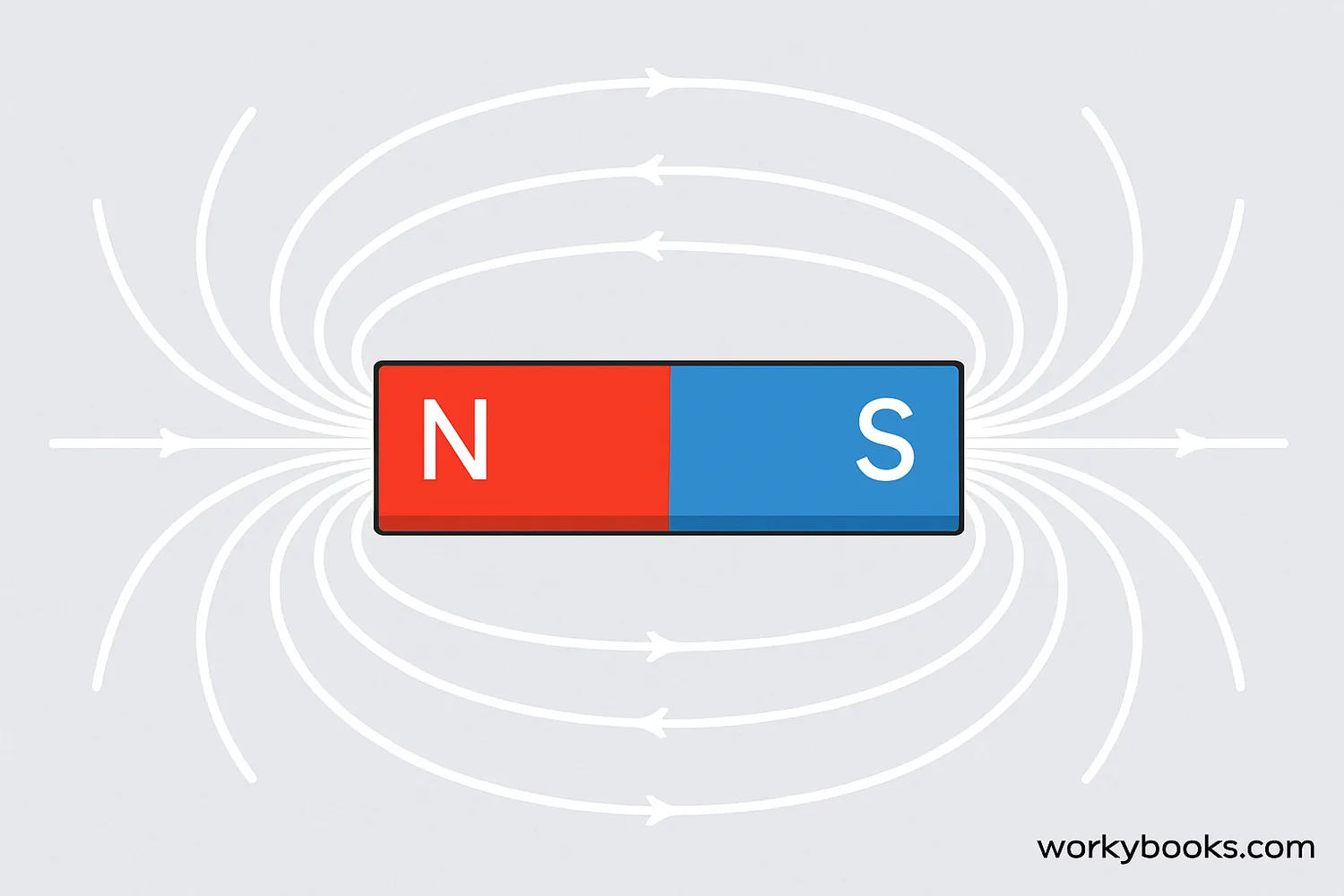
Magnetic field lines show the direction and strength of a magnetic field
Magnetic fields are regions surrounding a magnet where magnetic forces can influence other objects. When a magnet is placed near small metal objects like iron filings, these filings align in patterns that reveal the otherwise invisible field. The study of magnetic fields helps scientists understand how forces act without direct contact, shaping our understanding of physical interactions in nature.
How Magnetic Fields Work At the center of every magnet are charged particles called electrons. As electrons move, especially in certain metals, they create a magnetic field. This field is strongest at the poles—the ends of a magnet labeled north and south. The field gets weaker as you move away from these poles. Scientists visualize magnetic fields using field lines: lines that show the direction and strength of the force. Field lines always exit from the north pole and enter at the south pole. They never cross, and where the lines are closest together, the magnetic force is strongest. For instance, sprinkling iron filings around a bar magnet causes the filings to align along these invisible field lines, showing the pattern of the magnetic field.
Comparing Magnetic, Gravitational, and Electric Fields Magnetic fields are a type of force field, similar to gravitational fields (which pull objects toward each other) and electric fields (which act between electric charges). All three fields can act at a distance, meaning objects do not need to touch to exert a force. For example, the gravitational field of Earth keeps the Moon in orbit, and the magnetic field of a magnet can move a paperclip without touching it. Unlike gravitational fields, which only attract, magnetic and electric fields can both attract and repel, depending on the poles or charges involved. The strength of a magnetic field decreases rapidly with distance—doubling the distance from a magnet makes the force four times weaker.
Applications and Broader Implications Magnetic fields have many real-world uses. The Earth itself acts like a giant magnet, with a magnetic field that protects us from harmful solar radiation and helps animals navigate. Compasses rely on Earth’s magnetic field for direction. Technologies like electric motors, MRI machines in hospitals, and data storage devices all depend on precise control of magnetic fields. Understanding how fields interact with matter has led to important advances in transportation, medicine, and communication.
Magnetic fields illustrate a key scientific principle: forces can act at a distance, shaping the structure and behavior of the universe. By comparing magnetic, gravitational, and electric fields, scientists can better understand the fundamental connections among objects and energy in our world.
Interesting Fact: The Earth’s magnetic field is strong enough to make a compass needle point north, but it is about 100 times weaker than the magnet in your refrigerator.
What is a magnetic field?
The area around a magnet where magnetic forces actA special type of electric currentA visible pattern on a magnetThe location of the magnet's poles
Where is the magnetic field the strongest on a magnet?
In the middleAt the polesFar away from the magnetOn the sides
What do iron filings show when placed near a magnet?
They reveal the shape of the magnetic fieldThey create a new magnetic fieldThey turn into magnetsThey lose their magnetic properties
How do field lines behave around a magnet?
They cross over each otherThey go from the north pole to the south poleThey form circles around the magnetThey only exist at the poles
What happens to the strength of a magnetic field as you move farther from the magnet?
It gets strongerIt stays the sameIt gets weakerIt reverses direction
In the passage, what is a gravitational field?
A region where gravity pulls objects toward each otherA region where electric forces actA type of magnetic fieldA place with no force
What is one similarity between magnetic, electric, and gravitational fields?
They all require objects to touchThey all act at a distanceThey are all visible to the eyeThey only exist in magnets
Which of the following statements is true?
Magnetic fields can both attract and repel objectsGravitational fields can repel objectsOnly electric fields act at a distanceMagnetic fields never change
Magnetic field lines never cross each other. (True/False)
TrueFalse
Earth’s magnetic field is stronger than a refrigerator magnet. (True/False)
TrueFalse
Perfect For:
👩🏫 Teachers
• Reading comprehension practice
• Auto-graded assessments
• Literacy skill development
👨👩👧👦 Parents
• Reading practice at home
• Comprehension improvement
• Educational reading time
🏠 Homeschoolers
• Reading curriculum support
• Independent reading practice
• Progress monitoring
Reading Features:
📖
Reading Passage
Engaging fiction or nonfiction text
❓
Comprehension Quiz
Auto-graded questions
📊
Instant Feedback
Immediate results and scoring
📄
Printable Version
Download for offline reading
🔊
Read Aloud
Voice-over with word highlighting
Reviews & Ratings
No reviews yet. Be the first to share your experience!
Related Content
Types of Magnets
This science passage for grades 6-8 explains the types of magnets—permanent, temporary, natural, and briefly electromagn...
MS-PS2-3
Magnetic Materials
This passage, aligned to NGSS standard MS-PS2-3, explores the science behind magnetic materials and their importance in ...
MS-PS2-3
What Is Electricity?
This middle school science passage introduces the concept of electricity, aligned with NGSS standard MS-PS2-3. Students ...
MS-PS2-3
Electric Charge
This comprehensive middle school science passage introduces the concept of electric charge as a fundamental property of ...
MS-PS2-3
How Charges Interact
This standards-aligned passage for grades 6-8 introduces students to how electric charges interact, focusing on the fund...
MS-PS2-3MS-PS2-5
Electric Current
This comprehensive middle school science passage, aligned with NGSS standard MS-PS2-3, introduces students to the concep...
MS-PS2-3
Electric Circuits
This middle school science passage explores electric circuits in depth, aligning with NGSS standard MS-PS2-3. Students w...
MS-PS2-3
Series and Parallel Circuits
This informative passage for grades 6-8 explains the scientific mechanisms behind series and parallel electrical circuit...
MS-PS2-3
Electrical Safety
This comprehensive informational passage for grades 6-8 explores the science behind electrical safety, focusing on the m...
MS-PS2-3
Voltage
This comprehensive passage for grades 6-8 explores the concept of voltage, defined as the electrical potential differenc...
MS-PS2-3
Resistance
This engaging middle school science passage explores the concept of resistance, a fundamental idea in the study of elect...
MS-PS2-3
Static Electricity
This passage provides a comprehensive exploration of static electricity, aimed at students in grades 6-8 and aligned wit...
MS-PS2-3MS-PS2-5
Electricity and Magnetism Connection
This comprehensive science passage for grades 6-8 explores the deep connection between electricity and magnetism, beginn...
MS-PS2-3MS-PS2-5
Electromagnets
This middle school science passage introduces students to electromagnets, aligning with NGSS standard MS-PS2-3. It cover...
MS-PS2-3
Uses of Electromagnets
This engaging middle school science passage explores the uses of electromagnets, aligned with NGSS standard MS-PS2-3. St...
MS-PS2-3
Electromagnetic Induction
This middle school science reading passage explores the concept of electromagnetic induction, focusing on Faraday's grou...
MS-PS2-3MS-PS3-5
Electric Motor
This comprehensive middle school science passage explores the science of electric motors, aligning with NGSS standards M...
MS-PS2-3MS-PS3-5
How Transformers Work
This middle school science passage explores the science of transformers—devices that change the voltage of electricity u...
MS-PS2-3
Strength of Electromagnets
This middle school science passage explores the factors that affect the strength of electromagnets, including the number...
MS-PS2-3
Magnetic Force
This comprehensive science passage for grades 6-8 explores the mechanisms behind magnetic force, including how magnet st...