Magnetic Poles
Interactive passage with audio narration, comprehension questions, and printable PDF.
What's included
Magnetic Poles preview and details
About this printable Magnetic Poles science reading passage, NGSS-aligned (Grades 5-8)
Sample passage and quiz from Magnetic Poles
Reading passage and comprehension quiz preview
Magnetic Poles
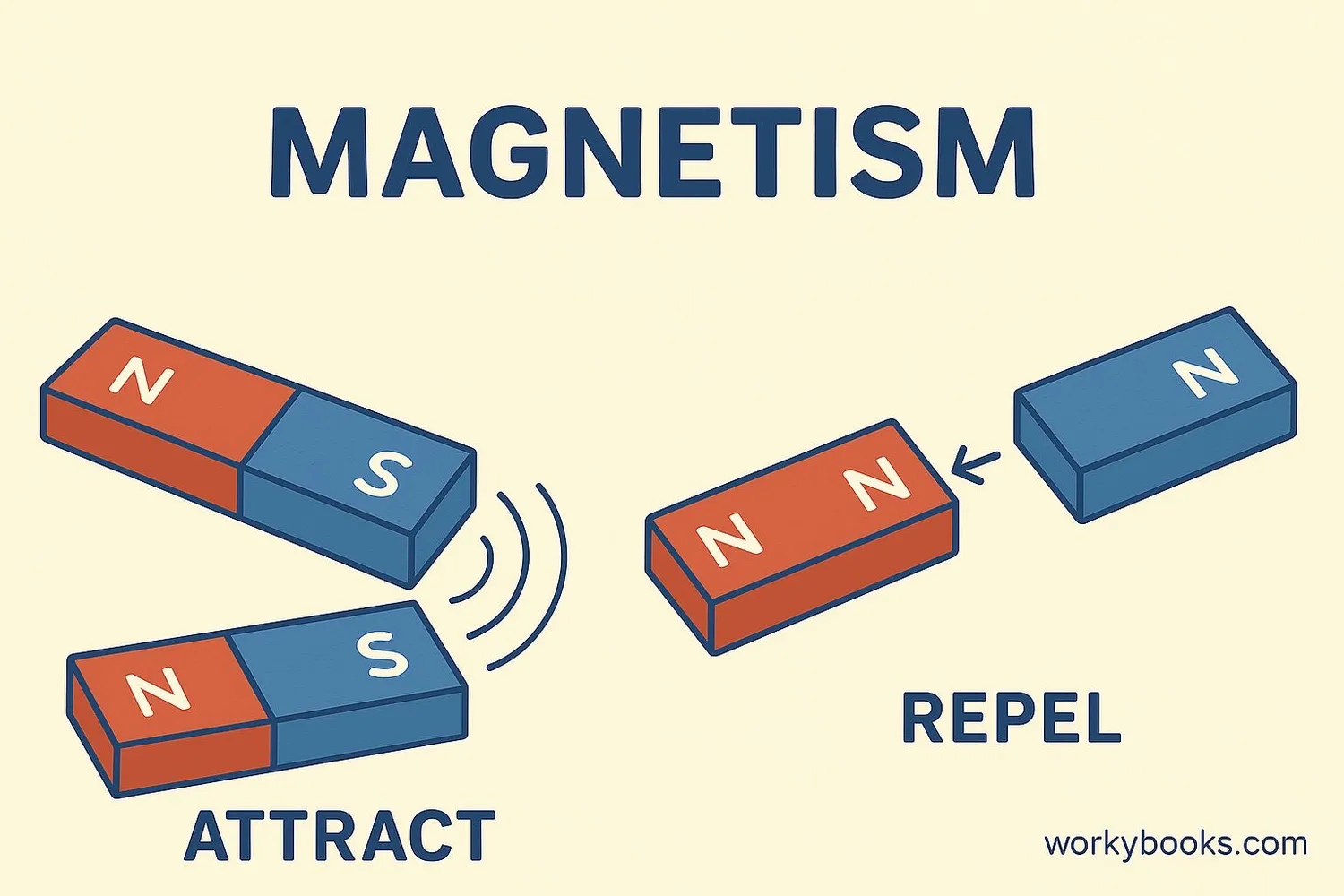
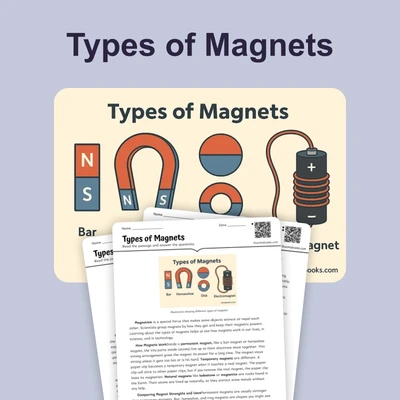
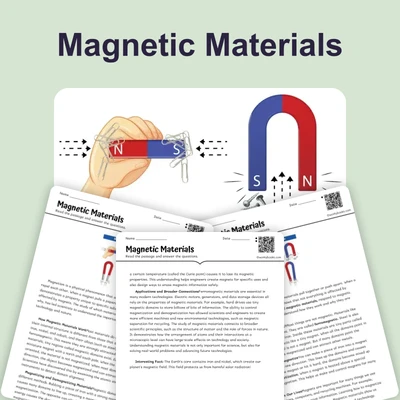
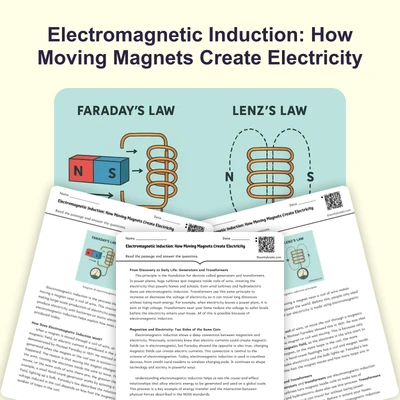
Magnets are essential tools in science and technology because they can attract certain metals and influence electronic devices. Each magnet has two special regions called magnetic poles. These are known as the north pole and south pole. The law of magnetic poles states that like poles repel each other, while opposite poles attract. This predictable interaction is a key phenomenon in physics and explains how magnets behave in different situations.
How Magnetic Poles Work
The force between magnetic poles is caused by the movement of tiny particles called electrons inside the magnet. These particles create a magnetic field, which extends outward from the poles. The direction of this field determines the behavior of the magnet. When two north poles or two south poles are brought close together, their magnetic fields push against each other, causing repulsion. If a north pole meets a south pole, their fields merge and pull together, causing attraction. The strength of these forces can be measured, and laboratory tests show that the force grows stronger as the poles get closer—doubling the distance can reduce the force by up to 75%.
Poles Cannot Be Separated
No matter how many times you break a magnet, each piece will always have both a north and a south pole. This is because the atomic structure of the magnet aligns in a way that keeps both poles present. Unlike electric charges, you cannot isolate a single magnetic pole, which scientists call a magnetic monopole. Experiments have shown that even the tiniest fragment of a magnet forms its own north and south poles. The names "north-seeking" and "south-seeking" come from the fact that a free-moving magnet, like a compass needle, will align itself with Earth's magnetic field, pointing toward the planet's geographic North and South Poles.
Applications and Broader Connections
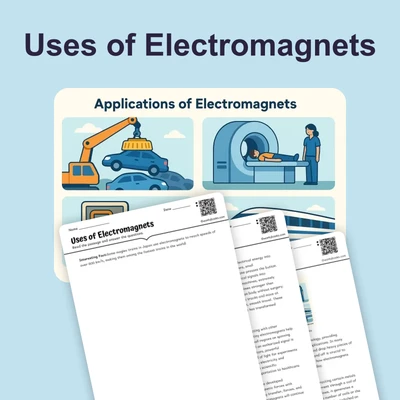
Magnetic poles are crucial in many real-world technologies, from simple compasses to advanced electric motors and MRI machines. The understanding of poles enables engineers to design devices that convert electrical energy into motion, which is essential in transportation and manufacturing. Magnetic storage devices, such as hard drives, also rely on these principles to encode data. Scientists continue to study magnetism to develop new materials and improve energy efficiency. The study of magnetic poles links to broader scientific principles like the conservation of energy and the fundamental forces of nature.
Understanding magnets and their poles helps explain not just how everyday objects work but also how invisible forces shape the universe.
Interesting Fact: The Earth's core acts like a giant magnet, creating a massive magnetic field that protects the planet from harmful solar radiation.
Comprehension quiz (10 questions)
1. What are the two poles of a magnet called?
2. What happens when two like poles are brought close together?
3. Why can't magnetic poles be separated?
4. What is the name for a hypothetical particle with only one magnetic pole?
5. Which of the following best describes the effect of distance on magnetic force between two poles?
6. In the passage, what causes the magnetic field inside a magnet?
7. How do we know which end of a magnet is the north pole?
8. Which of the following is NOT a real-world application of magnetic poles mentioned in the passage?
9. True or False: Breaking a magnet in half creates one piece with only a north pole and one with only a south pole.
10. True or False: The Earth's magnetic field protects us from harmful solar radiation.
Perfect for the way you teach
- Build comprehension skills
- Auto-graded quiz
- Differentiated reading
- Read together at home
- Improve fluency
- Quiet reading time
- Reading curriculum support
- Independent practice
- Track Lexile growth